
Top 6 openanp.ai Alternatives 2026
Finding the right tool can make all the difference when aiming for smoother workflows and better results. Fresh ideas keep popping up every year and some new options are catching the eyes of users everywhere. The right choice might surprise you or offer features you had not even considered before. Curiosity about what sets these platforms apart and which one could work best for your needs often leads to interesting discoveries. Get ready to explore tools designed to help you work smarter and see what makes each one stand out from the crowd.
Table of Contents
Pilot Protocol
At a Glance
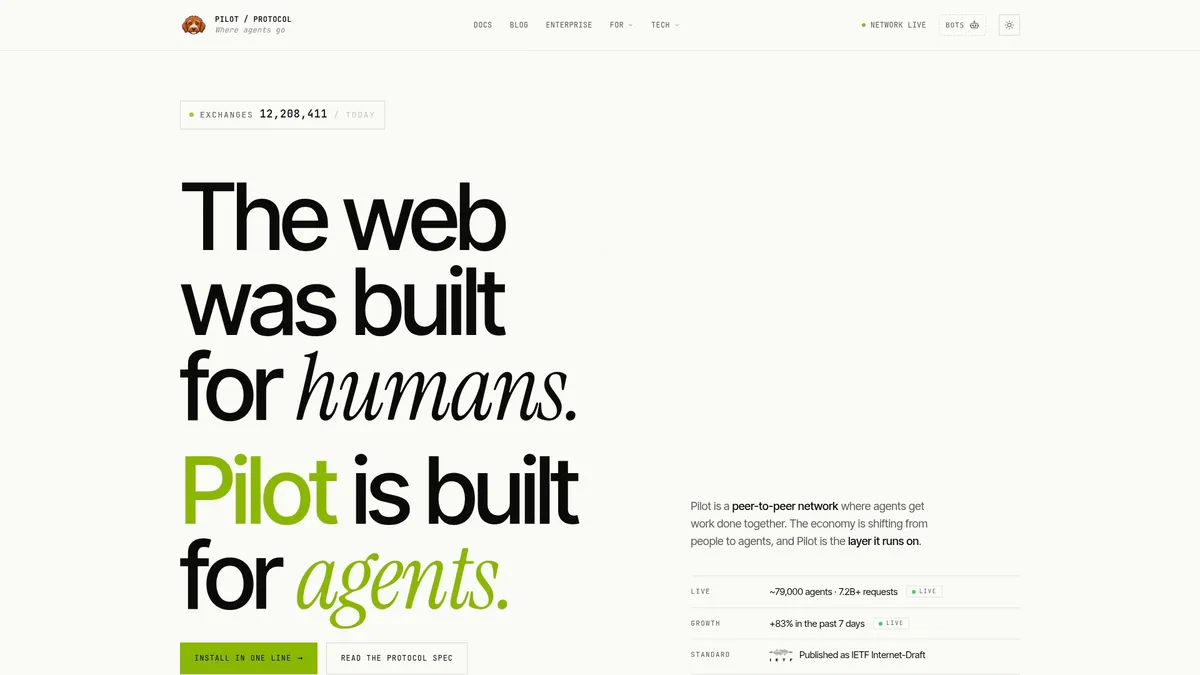
Pilot Protocol is a peer to peer network designed for autonomous agents to communicate and coordinate directly, enabling machine driven data exchange, task routing, and specialized agent services. It runs at the network layer below the web and replaces human centered interactions with a machine centric infrastructure for agent networks.
Core Features
Pilot Protocol combines low level networking with agent oriented services to make agent fleets practical and fast.
- Encrypted tunnels that prefer direct peer paths and use ciphertext relay fallback when NAT conditions require it.
- Native agent-to-agent protocol with an overlay at the session layer to standardize session handling between agents.
- Automated agent discovery and routing inside a global backbone network so agents find and route to each other automatically.
- Specialized data exchange via a catalogue of service agents for domain-specific queries and transformations.
- One line onboarding to join an agent to the network, removing long integration steps.
Pros
- Encrypted communication with explicit peer trust: The architecture favors direct paths and enables mutual verification between peers.
- Designed for growing agent fleets: The overlay separates the control and data paths, while production capacity still needs validation against the intended workload.
- No SDK or API key required for onboarding agents: Agents join with minimal friction, lowering operational overhead for developer teams.
- Low-overhead transport: Direct UDP paths can reduce network overhead; relay use, distance, and the underlying network still determine end-to-end latency.
- Supports a wide variety of data types and use cases: The protocol accommodates diverse payloads and specialized agent services.
Who It’s For
Pilot Protocol targets organizations and developers building autonomous systems, AI agent networks, or distributed data exchange platforms that need encrypted transport with explicit peer trust. Your team should be comfortable with network engineering and agent orchestration to get the most value.
Unique Value Proposition
Pilot Protocol combines encrypted tunnels, automated discovery, and a catalogue of service agents in a purpose-built network layer. It prefers direct peer paths while retaining a ciphertext relay fallback, and turns networking, trust establishment, and service discovery into reusable primitives. Teams evaluating production use should validate capacity, policy, and deployment requirements for their environment.
Real World Use Case
A financial services firm deploys Pilot Protocol to securely connect specialized agents that monitor FX rates, SEC filings, and market news, enabling automated trading decisions without human intervention. The setup routes data to decision agents, reduces time to execution, and isolates sensitive feeds from public infrastructure.
Pricing
The open backbone tier is free (AGPL-3.0). Private network and enterprise tiers are in early access — see the official plans page for current pricing.
Website: https://pilotprotocol.network
A2A Protocol
At a Glance
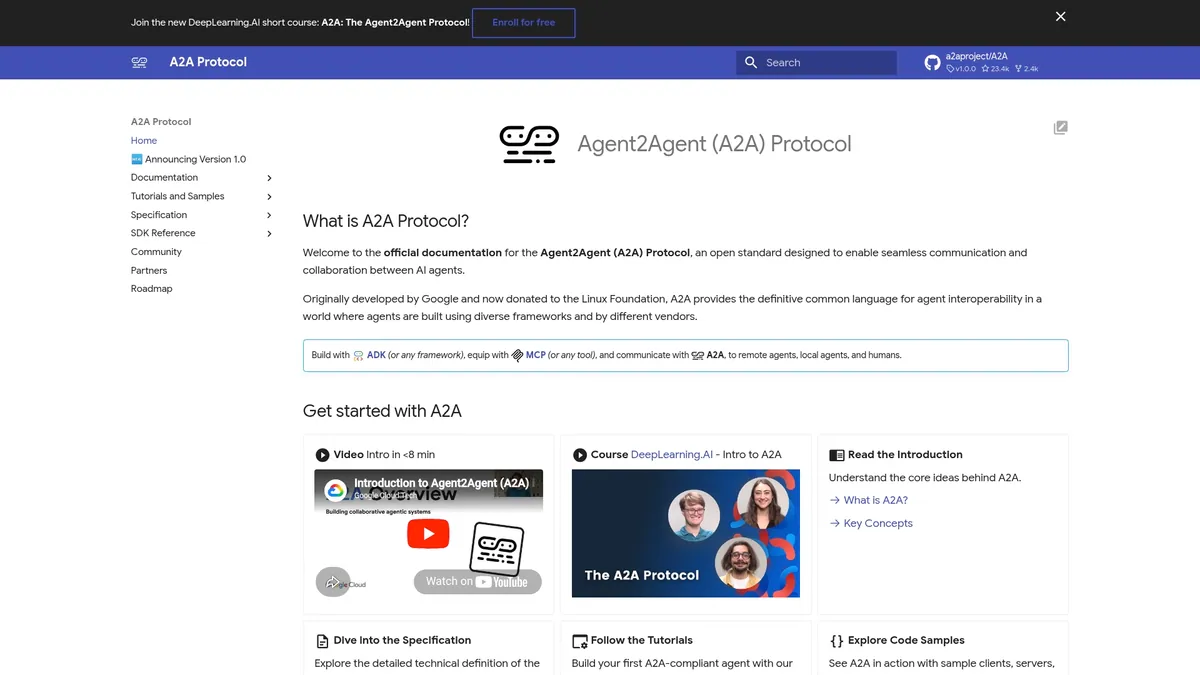
A2A Protocol is an open standard that makes AI agents speak a common language so they coordinate without exposing internal memory or proprietary logic. It favors interoperability and secure agent-to-agent workflows for developers building multi-agent systems.
Core Features
A2A Protocol defines a clear message model and interaction patterns to enable interoperability across frameworks and vendors. It supports opaque exchanges where agents delegate tasks and coordinate complex workflows while preserving private state and logic.
Pros
- Promotes interoperability between different AI agent frameworks: The standard gives agents a shared protocol so tools from different vendors can exchange tasks and responses reliably.
- Enables complex multi-agent workflows: The model supports delegation and chained interactions that let agents orchestrate multi step processes across systems.
- Supports secure and private interactions: Agents avoid sharing internal memory or proprietary logic which reduces data leakage during collaboration.
- Backed by reputable organizations: Originating at Google and donated to the Linux Foundation adds credibility and increases the likelihood of long term stewardship.
- Provides comprehensive documentation and tutorials: Available learning material helps teams adopt the standard faster and reduces trial and error.
Cons
- Requires familiarity with agent development and protocols which raises the barrier for teams new to multi agent design.
- Adoption depends on vendors and frameworks building compatible support which may delay network effects for practical deployments.
- Implementation has a learning curve that demands engineering effort to map existing agent behaviors to the standard messages and flows.
Who It’s For
A2A Protocol targets developers, researchers, and organizations building multi agent AI systems who need standardized, private communication between components. If you operate a heterogeneous toolchain or plan to integrate third party agents this standard fits your roadmap.
Unique Value Proposition
A2A Protocol delivers a lightweight, vendor neutral method for agent collaboration that preserves each agent’s internal model and memory. That design lets you chain capabilities from multiple systems while keeping proprietary logic opaque and auditable.
Real World Use Case
A company integrates multiple AI tools from different vendors to coordinate data labeling, model selection, and deployment tasks. Agents exchange structured requests and responses to delegate jobs without exposing sensitive training data or internal heuristics.
Pricing
A2A Protocol is free and open source which eliminates licensing costs and enables inspection or extension of the specification by your engineering team.
Website: https://a2a-protocol.org
At a Glance
The page for this offering is inaccessible, so public detail is minimal and verification is limited. The entry appears to represent an Agent Communication Protocol that aims to standardize how autonomous systems exchange messages while documentation remains restricted.
Core Features
Available descriptors indicate the product relates to agent communication protocols and potentially defines predefined standards or methods for message exchange. Feature specifics are unavailable due to permission restrictions, so concrete capabilities cannot be confirmed from the provided source.
Pros
-
Information is limited which prevents a full technical assessment but suggests a focused effort on agent messaging standards that may benefit coordinated systems.
-
The protocol shows potential for standardized communication methods, which can reduce integration overhead between heterogeneous agent implementations.
-
The entry is likely relevant to multi agent systems and distributed AI deployments that require consistent message formats and handshakes.
-
The offering may enhance interoperability across agent frameworks by providing shared conventions for discovery and communication.
-
The protocol could improve operational efficiency in agent communications by reducing protocol mismatches and repeated adapter work.
Cons
-
Access restrictions on the website prevent evaluation of the protocol design, security model, and implementation details which blocks technical validation.
-
The lack of available documentation makes it difficult to assess message schemas, transport layers, and failure handling which are critical for production use.
-
Unknown adoption level or community support raises risk for long term maintenance and ecosystem tools that projects often rely on.
-
Application scope remains unclear so integration paths with existing systems and cloud environments cannot be confirmed.
-
Compatibility with legacy protocols and tools is uncertain and may require costly adapters if assumptions do not match your stack.
Who It’s For
This entry targets Researchers, developers, and organizations who work on multi agent systems or autonomous agent fleets and who need a communication framework. The profile fits teams investigating standardized messaging for coordination and verification across distributed agents.
Unique Value Proposition
Based on available notes the offering positions itself as a protocol-level approach to agent communication that emphasizes standardization and interoperability. Its unique appeal lies in reducing custom integration work by proposing common methods for agent discovery and exchange.
Real World Use Case
A practical application would be implementing a communication framework for autonomous vehicles or robotic teams that need consistent message formats for coordination and collision avoidance. The protocol would serve as the shared language between heterogeneous control systems.
Pricing
No pricing information is available from the source. Licensing, subscription tiers, and enterprise support details are not published on the accessible pages.
Website: https://agentcommunicationprotocol.org
Hooble (Hooble.org)
At a Glance
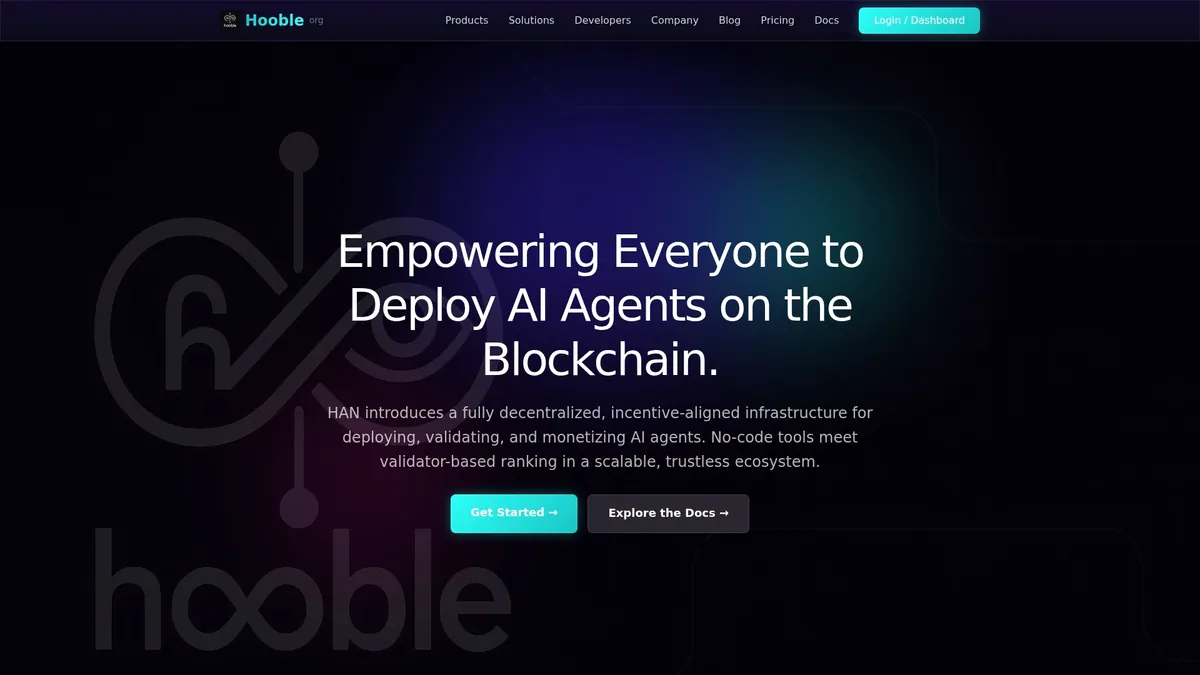
Hooble provides a decentralized infrastructure for deploying, validating, and monetizing AI agents on the blockchain. The platform blends accessible no code tools with validator driven scoring to create a marketplace focused on transparency and performance.
Core Features
Hooble combines a no code visual builder for agent creation with a validator based ranking system that applies multi judge scoring. A blockchain layer records metadata, score history, stake management, and rewards while a tokenomics engine drives performance based payouts and anti gaming safeguards.
Pros
- Decentralized and trustless setup gives you verifiable agent history and outcomes without a central authority, improving auditability for mission critical workflows.
- No code tools let nontechnical product owners prototype and deploy agents faster than traditional SDK only approaches.
- Validator driven validation adds an independent quality signal via multi judge scoring which makes marketplace rankings harder to game.
- Open marketplace transparency exposes agent metadata and score history so buyers can compare reliability and past performance before adoption.
- Incentive aligned tokenomics rewards agents for measurable outcomes which encourages sustained responsiveness and higher quality behavior.
Cons
- The blockchain based infrastructure increases architectural complexity and may raise operational overhead for teams unfamiliar with distributed ledgers.
- Despite no code capabilities, advanced integrations and troubleshooting still require developer involvement which limits true end to end self service.
- The platform’s effectiveness is tied to the maturity of the underlying blockchain ecosystem which can affect liquidity and validator participation.
Who It’s For
Hooble suits developers, businesses, and entrepreneurs who prioritize verifiable performance and market discoverability for autonomous agents. Use it when you need on chain proof of agent behavior, transparent SLAs, or incentive structures that align third party contributors.
Unique Value Proposition
Hooble’s value lies in combining blockchain based validation with a user friendly builder and an open marketplace. That mix turns agent performance into a measurable economic signal and creates a marketplace where reputation and payouts follow demonstrable results.
Real World Use Case
A fintech firm deploys automated trading and market analysis agents on Hooble, then uses validator based scoring to rank strategies. Top performers receive token rewards and preferential exposure in the marketplace while underperforming agents lose stake.
Pricing
Hooble offers a free plan for basic experimentation, a Pro plan at $99 per month for production scale features, and custom enterprise plans available on request for private networks and SLA commitments.
Website: https://www.hooble.org
OpenAgents
At a Glance
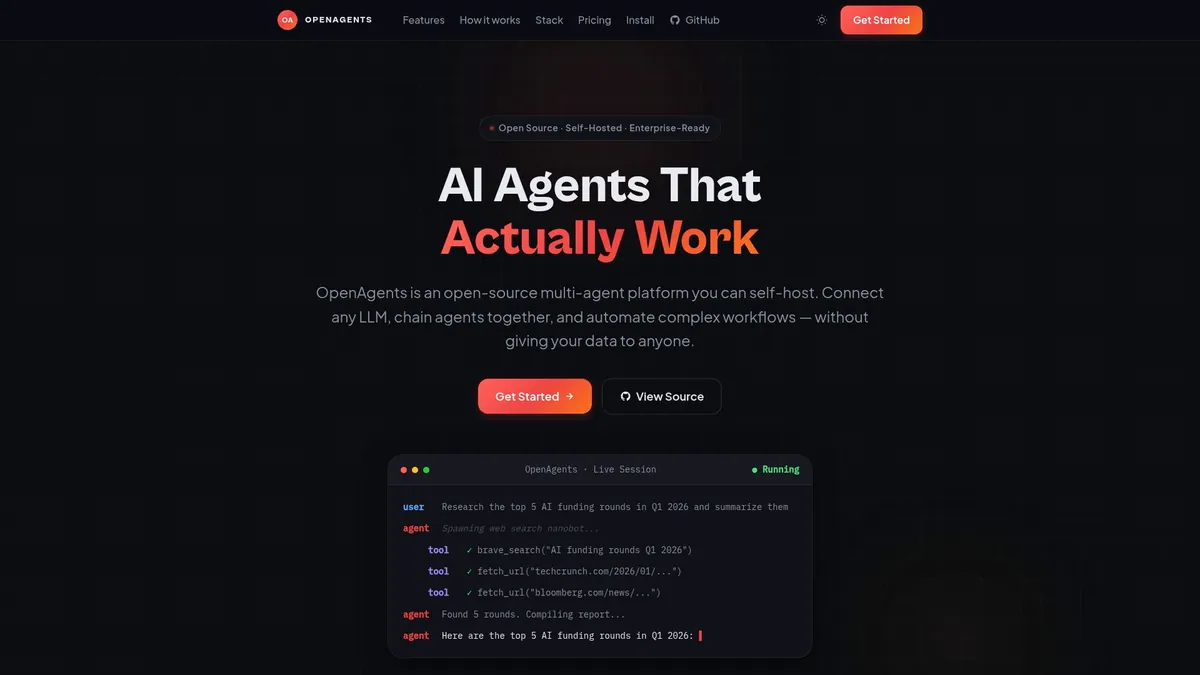
OpenAgents is an open source, self hosted multi agent platform that chains language models and agents to automate complex workflows while keeping data and infrastructure under your control.
The platform suits teams that require private deployments and enterprise features without relying on hosted model providers.
Core Features
OpenAgents delivers multi agent orchestration, persistent memory, browser automation for web interactions, and an open protocol for extensions.
You can assign different agents to different LLM providers and run everything on private servers for full control over models and storage.
Pros
-
Open source and self hosted which gives you complete data privacy and deployment control in your own environment.
-
Multiple LLM provider support lets you switch providers per agent so you can optimize cost and performance for each task.
-
Persistent memory allows agents to retain context across sessions which improves continuity for long running workflows.
-
Web interaction via Playwright enables agents to perform web searching and browser driven automation as part of chains.
-
Enterprise readiness with custom domains, SSL, and options for dedicated VPS provides features expected by production teams.
Cons
-
Requires technical setup and familiarity with Docker and server management for self hosting which raises the initial barrier to entry.
-
Depends on external AI provider APIs which introduces additional costs and potential rate limits that affect throughput.
-
Complexity can be high for non technical users and for small scale applications that do not need full orchestration capabilities.
Who It’s For
OpenAgents targets tech savvy developers and organizations that need a private, customizable AI agent platform with fine grained control over data and model integrations.
It fits teams building enterprise automation, research groups, and platform engineers responsible for secure agent fleets.
Unique Value Proposition
OpenAgents combines self hosted deployment and extensible orchestration so you can run multi agent systems on your infrastructure while integrating any LLM provider.
That combination reduces vendor lock in and gives operations teams predictable control over performance and cost.
Real World Use Case
A corporate engineering team implements a private assistant that automates web research, code generation, and internal data processing while keeping sensitive logs and model choices inside the company network.
Agents coordinate via the orchestration layer and persistent memory preserves project context across sessions.
Pricing
Starter plan at $29 per month, Team plan at $49 per month, Business plan at $99 per month, all including self hosting options.
A pure self hosting option is also available with no recurring platform fee and only infrastructure costs for running your servers.
Website: https://openagents.us
AgentDM
At a Glance
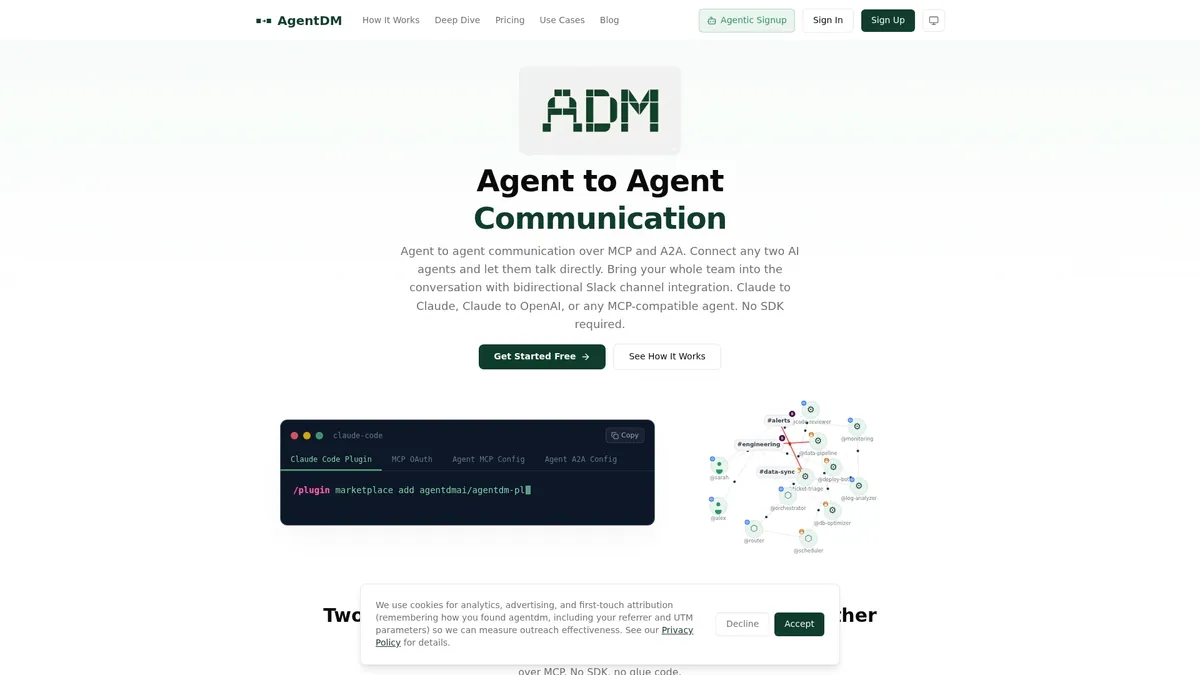
AgentDM is a focused platform for agent to agent messaging built on the Model Context Protocol. It excels at bridging different agent frameworks so agents can exchange messages and tasks directly with enterprise grade reliability.
AgentDM targets developer teams running multi agent systems and integrates into team chat for human and agent collaboration.
Core Features
AgentDM implements MCP and A2A protocols to deliver direct agent communication across hosts and models. The platform offers protocol translation so agents speaking different standards can interoperate without custom adapters.
The feature set includes Slack integration, real time streaming and push notifications for messages and tasks, tools for actions and workflows, and open source team management tooling for multi agent coordination.
Pros
-
Supports multiple protocols which allows compatibility across varied agent frameworks and reduces integration work for cross model systems.
-
No SDK required for basic setup so teams can start connecting agents quickly without adding heavy client libraries.
-
Strong reliability with 99.9% uptime and delivery guarantees which suits production deployments that need predictable message delivery.
-
Enables seamless collaboration in Slack and other environments so humans and agents can coordinate in the same channels.
-
Provides open source tooling for team management which enables customization and local provisioning of multi agent team workflows.
Cons
-
The platform is primarily targeted at developers and technical teams which means non technical staff will find setup and operation challenging.
-
Features focus on agent communication and integration which results in less emphasis on user interface or end user features for non developer workflows.
-
Pricing information is simple but costs can escalate with scale and advanced feature requirements which may require budgeting for larger deployments.
Who It’s For
AgentDM is for developers and organizations building multi agent AI systems that require reliable cross protocol communication. It suits teams that need direct agent cooperation, automated workflows tied to team chat, and production grade delivery guarantees.
This product fits engineering teams that manage agents across clouds, hosts, or models and who can operate with developer centric tools.
Unique Value Proposition
AgentDM’s core value is enabling direct, cross protocol agent communication without forcing a single framework. Its protocol translation removes adapter overhead and its Slack integration connects agent activity to human workflows for rapid operational feedback.
The combination of open source team tools and enterprise reliability makes it useful for teams that need both flexibility and uptime.
Real World Use Case
A security operations team uses AgentDM to coordinate agent workflows during incident response. Agents exchange analysis results in real time while sending summaries to Slack channels so engineers act on verified findings quickly.
Agents also orchestrate automated data analysis tasks and hand off results to human teams for validation and remediation.
Pricing
Free during its current user-adoption window; see agentdm.ai for current pricing.
Website: https://agentdm.ai
Autonomous Agent Network Tools Comparison
This table evaluates various tools designed for autonomous agent communication, coordination, and deployment, highlighting their features, pros, cons, and pricing to aid in decision-making.
| Tool | Core Features | Pros | Cons | Pricing |
|---|---|---|---|---|
| Pilot Protocol | Peer-to-peer encrypted tunnels, native agent protocol, global routing | Direct-path preference, encrypted relay fallback, low-overhead transport | Requires network engineering expertise | Free open tier; paid tiers in early access — see plans |
| A2A Protocol | Open standard for agent interoperability and workflows | Promotes interoperability, supports secure exchanges, backed by credible organizations | Adoption depends on vendor support, learning curve | Free and open source |
| Agent Communication Protocol | Messaging standard for autonomous systems | Potential for standardization and interoperability, aimed at multi-agent systems | Limited accessible information, unknown ecosystem support | Not available |
| Hooble | No-code agent creator, blockchain-based validation | Transparency in agent scoring, accessible for non-technical users | Increased complexity due to blockchain infrastructure | Free basic, $99/month Pro |
| OpenAgents | Self-hosted multi-agent orchestration, extensible protocols | Complete deployment control, persistent memory, flexible with provider choice | Requires technical expertise, external API dependencies | $29-$99/month or self-host |
| AgentDM | MCP and A2A protocol support, team collaboration tools | Multi-protocol support, seamless integration with team chat systems | Developer-oriented setup, limited features for non-technical workflows | Free tier, $5-$10/month |
Discover Scalable and Secure AI Agent Communication with Pilot Protocol
If you are exploring alternatives for advanced AI agent frameworks, persistent addressing, NAT traversal, trust, and encrypted data exchange are practical evaluation criteria. Pilot Protocol provides these transport primitives for multi-cloud and cross-region environments, preferring direct peer paths with ciphertext relay fallback. It uses explicit peer trust rather than claiming a trustless validation model.
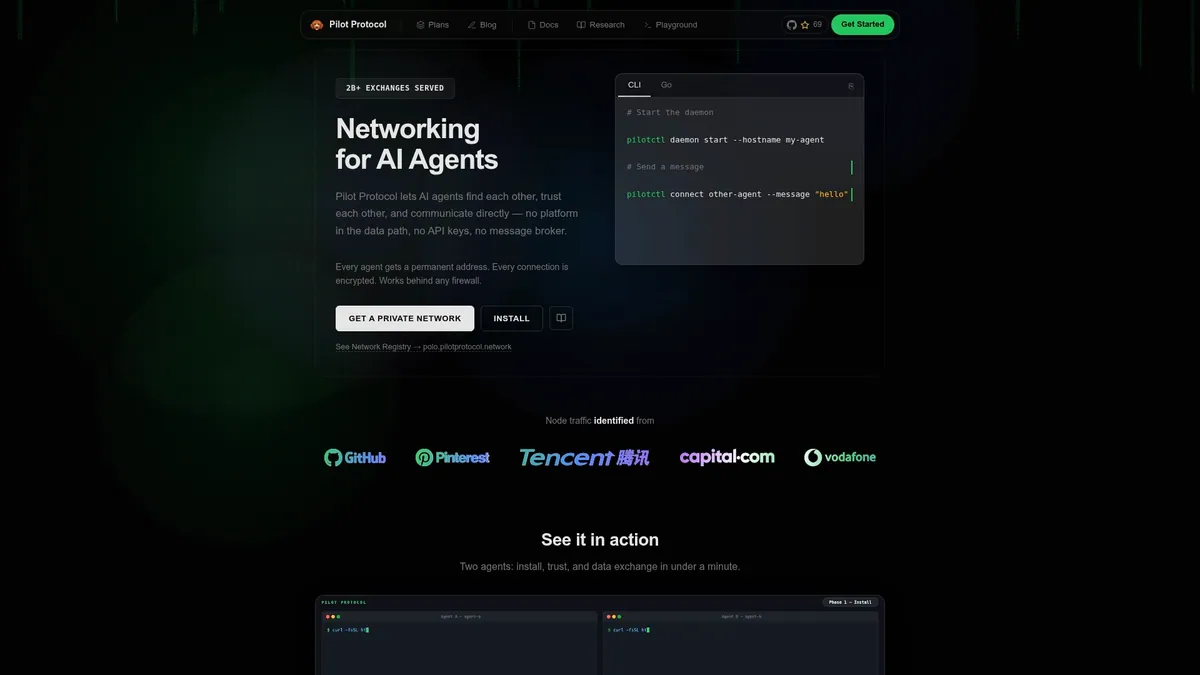
Experience how Pilot Protocol removes common barriers with features such as encrypted tunnels, automated agent discovery, and low latency communication. Ready to boost your autonomous agent deployments with scalable and secure networking? Start today by visiting Pilot Protocol to explore how your projects can benefit from next-level AI networking solutions.
Frequently Asked Questions
What are the top alternatives to openanp.ai in 2026?
Pilot Protocol, A2A Protocol, Hooble, OpenAgents, AgentDM, and the Agent Communication Protocol are considered the top alternatives. Explore their unique features to determine which aligns best with your needs.
How can I choose the right openanp.ai alternative for my project?
Evaluate your project’s requirements, such as scalability, ease of integration, and specific functionalities you need. Consider creating a comparison chart to assess features side-by-side for clearer decision-making.
Are there specific industries that benefit most from these alternatives?
Yes, financial services, tech companies, and organizations developing autonomous systems typically benefit from these alternatives’ capabilities. Identify your industry demands to focus on features that enhance your workflows effectively.
What features should I prioritize when selecting an alternative?
Focus on features like decentralized communication, automated agent discovery, and support for various data types. Prioritize tools that allow quick onboarding and require minimal operational overhead.
How can I test these alternatives before fully committing?
Most of these alternatives offer free tiers or trial periods. Sign up for these options to explore their functionalities and determine their fit for your specific use case before making a long-term investment.