
Top AI agent network examples for secure, scalable connectivity

TL;DR:
- Choosing the right AI agent network depends on decentralization, security, scalability, and cloud support.
- AgentNet excels in adaptive reasoning and dynamic topologies, ideal for complex, variable workloads.
- Google A2A emphasizes secure, cross-cloud interoperability with open protocols, suitable for multi-organization deployments.
Choosing the wrong AI agent network can silently break your distributed system. When agents can’t find each other reliably, when encrypted tunnels fail under cloud routing asymmetry, or when a framework collapses under real workload complexity, the cost isn’t just performance. It’s trust. AI developers and engineers building decentralized systems in 2026 face a real challenge: the landscape of agent networking frameworks is crowded, and benchmarks rarely tell the full story. This guide cuts through the noise, profiling three field-tested options, AgentNet, Google A2A, and ICP-based DeAI agents, with an honest comparison framework you can apply to your own multi-cloud stack.
Table of Contents
- How to evaluate AI agent network frameworks
- AgentNet: A decentralized, adaptive RAG-enhanced framework
- Google A2A: Enabling secure, cross-cloud agent interoperability
- DeAI on ICP: Onchain agents for sovereign, decentralized AI
- Head-to-head comparison: Which agent network fits your needs?
- A practitioner’s take: What most guides miss about agent networks
- Ready to build? Start with Pilot Protocol
- Frequently asked questions
Key Takeaways
| Point | Details |
|---|---|
| Agent network selection depends on use case | Benchmark results and architectural choices should match your operational and deployment requirements. |
| AgentNet excels at adaptive, decentralized reasoning | It leads in performance for autonomous multi-agent math and orchestration tasks. |
| A2A protocol powers secure, interoperable agent communication | It’s adopted by hundreds of organizations for multi-cloud and regulated enterprise integration. |
| Onchain networks like ICP enable sovereign DeAI | ICP hosts diverse real-world agents for onchain decisioning and composability. |
| No one-size-fits-all solution | Consider trade-offs in scalability, governance, and integration complexity for your needs. |
How to evaluate AI agent network frameworks
Before committing to any framework, you need a clear set of evaluation criteria grounded in real operational demands. The following core dimensions matter most when assessing a decentralized agent network:
- Decentralization: Does the network avoid single points of failure? Can agents operate without a central broker?
- Communication security: Does the framework support encrypted, authenticated channels by default?
- Composability: Can agents from different vendors or runtimes interoperate?
- Scalability: How does performance change under high agent counts or task concurrency?
- Multi-cloud support: Can the network span AWS, GCP, Azure, and private infrastructure without re-architecture?
Understanding the networking challenges specific to decentralized systems is step one. Common pitfalls include over-engineering with premature abstraction layers that increase latency, and under-engineering by ignoring NAT traversal and firewall complexity until agents fail silently in production.
Protocol choice matters too. Familiarize yourself with key agent protocols like A2A, MCP, and ANP before selecting a framework, since they define how agents discover and communicate with each other.
Benchmarks reveal varied strengths and weaknesses among popular frameworks and protocols. CrewAI’s sequential execution drives high token and latency overhead. LangGraph and AutoGen scale more effectively. Swarm prioritizes speed but loses accuracy as task complexity grows. These results mean your benchmarking context matters enormously: the task type, communication load, and transport protocol all shape results.
Byzantine tolerance in agent frameworks is another consideration that rarely appears in vendor documentation but is critical for production security. Agents operating in adversarial or open network environments need fault and tamper resilience built in.
Review secure infrastructure best practices before finalizing your stack to avoid common gaps around key management, agent identity, and transport encryption.
Pro Tip: Always run benchmarks against your specific task complexity and communication topology, not the vendor’s default demo workload. Results can shift dramatically under real traffic patterns.
AgentNet: A decentralized, adaptive RAG-enhanced framework
With criteria set, let’s dive into concrete examples, starting with specialized frameworks like AgentNet.
AgentNet is a decentralized multi-agent framework built around three core innovations: dynamic DAG (Directed Acyclic Graph) topology, RAG (Retrieval-Augmented Generation) for knowledge access, and local adaptive learning that allows individual agents to improve routing decisions over time without a central controller.
What makes AgentNet stand out is how it handles workload adaptation. Rather than fixed task pipelines, it restructures agent relationships dynamically based on task requirements. This is directly relevant to fluctuating cloud environments where resource availability changes without warning.
AgentNet outperforms other frameworks on MATH, API-Bank, and BBH tasks with gpt-4o-mini, achieving 85% on MATH, 32% on API-Bank, and 86% on BBH, consistently beating no-evolution baselines.
| Benchmark | AgentNet score | Baseline (no evolution) |
|---|---|---|
| MATH | 85% | Lower |
| API-Bank | 32% | Lower |
| BBH | 86% | Lower |
AgentNet is best suited for:
- Mathematical reasoning tasks where agents need to collaborate on multi-step problems
- API orchestration across heterogeneous services requiring dynamic routing
- Problem-solving domains where task structure isn’t known in advance
For teams building distributed agent networking infrastructure, AgentNet’s adaptive topology reduces the need for manual reconfiguration when cloud regions or service availability changes.
Pro Tip: Leverage dynamic DAG topologies when your workload has variable structure. Static pipelines waste compute and introduce unnecessary coordination overhead in multi-cloud agent deployments.
Google A2A: Enabling secure, cross-cloud agent interoperability
While AgentNet targets adaptive autonomy, let’s examine how A2A emphasizes secure discovery and scale.
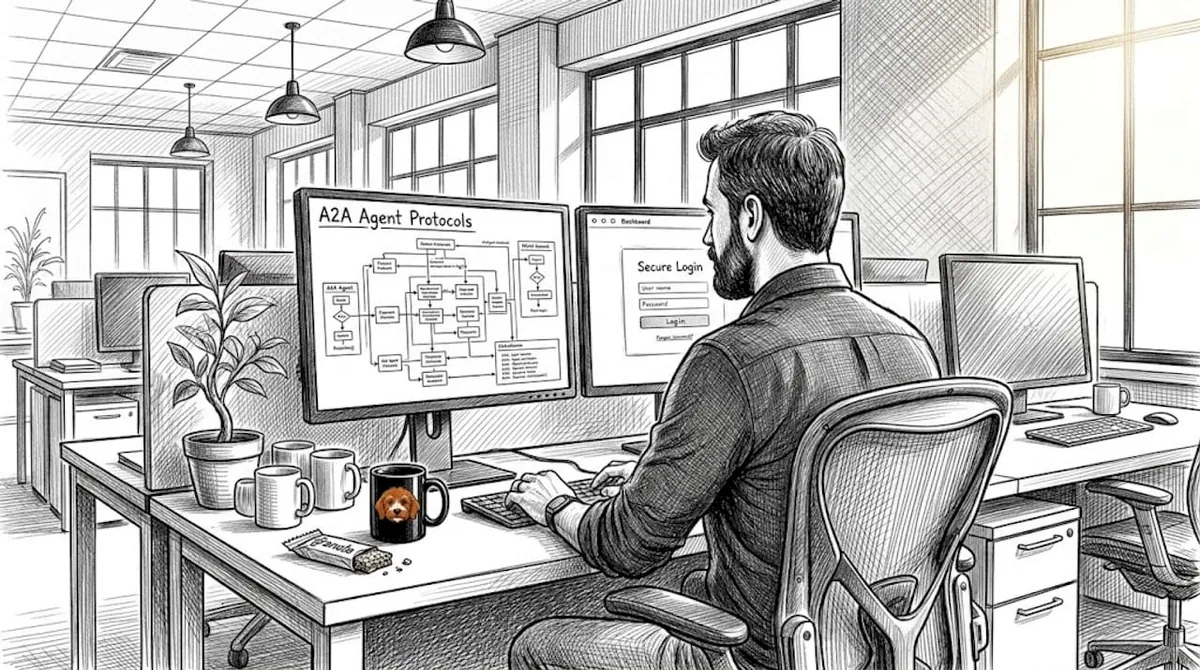
Google’s Agent-to-Agent (A2A) protocol takes a different approach. Rather than optimizing for single-framework intelligence, it defines a standard for how agents across vendors and clouds discover and communicate with each other. The core mechanism is the Agent Card, a structured JSON document that describes an agent’s capabilities, endpoints, and authentication requirements.
“A2A enables a future where specialized agents from different vendors collaborate seamlessly, without tight coupling or proprietary lock-in.”
A2A uses Agent Cards and open protocols for secure, multi-cloud agent discovery and communication, backed by 50+ partners including Salesforce and SAP. Communication runs over JSON-RPC via HTTP or gRPC, making it compatible with existing infrastructure. The protocol is now under Linux Foundation governance, which matters for regulated industries that require open, auditable standards.
A2A complements MCP (Model Context Protocol) rather than replacing it. A2A handles agent-to-agent coordination; MCP handles agent-to-tool interaction. Understanding that distinction is critical for architecture decisions. Explore the A2A protocol explained in detail before designing your discovery layer.
| Feature | A2A | AgentNet |
|---|---|---|
| Discovery mechanism | Agent Cards | Dynamic DAG routing |
| Security | JSON-RPC, open governance | Local adaptive trust |
| Ecosystem | 50+ partners | Research/production |
| Best for | Multi-vendor, regulated | Adaptive reasoning |
For A2A implementation details on real infrastructure, including how to route Agent Cards over encrypted tunnels, the use case aligns well with multi-organization enterprise deployments in regulated environments.
Choose A2A when you need cross-organization agent collaboration, broad ecosystem compatibility, and open governance to satisfy compliance requirements.
DeAI on ICP: Onchain agents for sovereign, decentralized AI
Beyond protocol frameworks, onchain networks like ICP redefine agent deployment and autonomy.
Internet Computer Protocol (ICP) offers a radically different model: AI agents that run entirely onchain inside canisters, which are smart contract-like compute units with persistent memory and HTTP-accessible endpoints. This eliminates reliance on any cloud provider and provides cryptographic guarantees about execution integrity.
Current ICP-hosted DeAI agents include LLM Canister for onchain language model inference, Anda Framework for composable and autonomous multi-agent systems, Alice for onchain decision execution, and DCA Agent for automated Ethereum token swaps.
Key benefits of running agents on ICP:
- Onchain integrity: Every execution is verifiable and tamper-resistant
- Ethereum bridging: Agents can interact with Ethereum smart contracts natively
- Persistent state: Canisters maintain memory across calls without external databases
- Sovereign execution: No cloud provider controls your agent runtime
To deploy a DeAI agent on ICP:
- Write your agent logic in Rust or Motoko targeting the canister interface
- Deploy using the DFINITY SDK (dfx) to the ICP mainnet
- Assign a stable canister ID as your agent’s persistent address
- Configure decentralized protocols for cross-chain and cross-agent communication
- Manage upgrades through governance proposals or controller keys
The trade-off is real: onchain compute is more expensive per operation and governance upgrades require deliberate process. But for agents where sovereignty and auditability matter more than raw throughput, ICP is a genuinely compelling option.
Head-to-head comparison: Which agent network fits your needs?
Having explored the top examples, here’s how they compare and when to choose each.
| Criteria | AgentNet | Google A2A | ICP/DeAI |
|---|---|---|---|
| Decentralization | High (no central broker) | Moderate (open protocol) | Maximum (onchain) |
| Security model | Adaptive local trust | JSON-RPC, Linux Foundation governance | Cryptographic onchain verification |
| Multi-cloud support | Yes, via dynamic topology | Yes, 50+ partner ecosystem | No (onchain only) |
| Composability | Task-level DAG routing | Agent Card discovery | Canister interfaces |
| Best use case | Math reasoning, API orchestration | Multi-vendor enterprise integration | Sovereign AI, DeFi agents |
| Operational complexity | Medium | Low to medium | High |
No single framework is best for all deployments. Trade-offs exist in speed, accuracy, composability, and decentralization. The right choice depends on your actual workload.
Practical guidance:
- Use AgentNet if your agents need to adapt their collaboration structure dynamically and your tasks involve complex reasoning or API chaining.
- Use Google A2A if you’re integrating agents across organizations or cloud providers and need open governance and broad ecosystem support.
- Use ICP/DeAI if your use case demands sovereign execution, onchain verifiability, or native Ethereum interoperability.
For teams operating across multiple clouds, review multi-cloud deployment strategies and multi-cloud security practices to ensure your networking layer keeps pace with your framework choice. Hybrid approaches, such as using A2A for discovery while routing over encrypted P2P tunnels, often outperform any single-framework deployment.
A practitioner’s take: What most guides miss about agent networks
Benchmarks and comparison tables are useful starting points. But after working with real agent deployments across multi-cloud environments, the gaps that actually break production systems rarely appear in vendor documentation.
The first blind spot is integration pain. A framework can score perfectly on benchmarks and still take weeks to integrate with your existing service mesh, secret management, and observability stack. That cost is invisible until you’re in it.
The second is resilience under edge cases. Agents that perform well on structured tasks can degrade badly when hit with malformed payloads, network partitions, or unexpected latency spikes. Real-world networking lessons show that Byzantine tolerance and graceful degradation separate production-ready stacks from demo-ready ones.
Third: security defaults. Many frameworks leave authentication and encryption as opt-in configurations. That’s a risk most regulated deployments can’t accept.
Pro Tip: Before committing to any framework, run a two-week pilot with real traffic diversity and cross-cloud load. You’ll surface practical issues that benchmarks won’t predict.
Ready to build? Start with Pilot Protocol
If you’re ready to start architecting your own agent networks, here’s the next logical step.
Pilot Protocol gives you the networking foundation your agent stack needs: encrypted P2P tunnels, persistent virtual addresses, NAT traversal, and mutual trust establishment across multi-cloud environments. Whether you’re running AgentNet-style dynamic topologies, routing A2A Agent Cards over secure channels, or connecting onchain ICP agents to your cloud services, Pilot Protocol handles the transport layer so your agents can focus on the work.
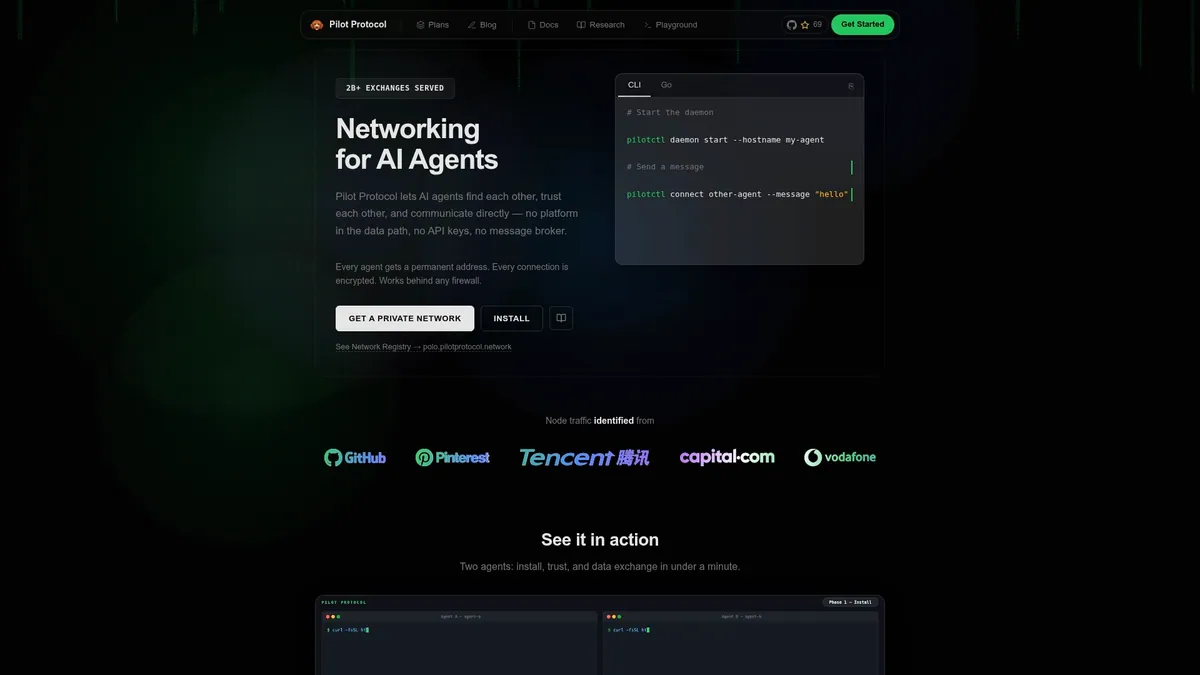
Explore the Pilot Protocol network stack to see how it fits your agent infrastructure. Review the documentation, walk through real deployment examples, and assess whether it’s the right foundation for your next agent-based project. Getting started takes minutes, not weeks.
Frequently asked questions
What is the difference between AgentNet and Google A2A?
AgentNet focuses on adaptive learning and decentralized intelligence through dynamic DAG topology, while Google A2A emphasizes secure cross-cloud agent interoperability through standardized Agent Cards and open protocol governance.
Where are onchain AI agents already deployed in production?
ICP hosts production DeAI agents including LLM Canister, Anda Framework, Alice, and DCA Agent, delivering autonomous and composable agent services with onchain execution guarantees.
Which agent network is best for highly secure, multi-cloud deployments?
Google A2A offers robust security, open governance under the Linux Foundation, and is adopted by 50+ organizations for multi-cloud agent interoperability. AgentNet and ICP suit more autonomous or onchain-specific needs.
What is a common pitfall when deploying agent networks at scale?
Many frameworks generate unexpected token and latency overhead, and accuracy degrades under high-complexity workloads, especially with sequential execution models or frameworks not designed for scale from the ground up.