
Top AI networking challenges for decentralized systems

Autonomous AI agents are reshaping how distributed systems communicate, but the networking layer has not kept pace. Unlike traditional web services with fixed endpoints and predictable traffic, agent networks are dynamic, cross-organizational, and often span multiple cloud providers simultaneously. No universal agent registry exists, and competing approaches like A2A Agent Cards, ANS, and decentralized DIDs each struggle with cross-org visibility. If you are building or operating agent fleets today, you are navigating a landscape where legacy networking assumptions actively work against you. This article breaks down the seven biggest challenges and how current solutions stack up.
Table of Contents
- Criteria for evaluating AI networking solutions
- 1. Agent discovery in decentralized environments
- 2. Establishing trust and authentication
- 3. NAT traversal and inter-agent connectivity
- 4. Protocol heterogeneity and interoperability
- 5. Multi-cloud networking: Cost, latency, and reliability
- 6. Scalability and load balancing in agent networks
- 7. Edge cases and unsolved problems
- Comparison summary: AI networking challenge solutions
- Build resilient AI networks with next-gen solutions
- Frequently asked questions
Key Takeaways
| Point | Details |
|---|---|
| Discovery is foundational | Identifying agents across organizations remains a major hurdle for decentralized AI networks. |
| Trust must be zero-trust | AI agent security relies on cryptographic authentication and point-to-point verification, not API keys. |
| NAT and protocol diversity | Most AI networks need advanced NAT traversal and multi-protocol support to reliably connect agents. |
| Scalability needs new stacks | Quadratic connection growth and multi-cloud distribution demand modern, agent-centric network stacks. |
Criteria for evaluating AI networking solutions
Before reviewing specific challenges, it helps to define what a capable AI networking solution actually needs to deliver. The requirements are different from what you would apply to a standard microservices stack.
Core requirements include:
- Discovery: Agents must locate each other without a centralized directory.
- Trust: Every interaction needs cryptographic verification, not just a shared secret.
- Connectivity: Agents behind NAT, firewalls, or different cloud providers must still reach each other.
- Efficiency: Low-overhead transport that scales with agent count.
- Protocol agility: Support for HTTP, gRPC, and emerging agent-specific protocols.
Zero trust frameworks are foundational here. The principle is simple: verify every interaction, apply data minimization, and enforce scoped permissions. Static endpoints and long-lived credentials do not fit this model.
The shift from static to dynamic identities is also critical. Traditional networking assumes you know who is connecting. Agent networks assume you do not, and must verify on every request. Cross-organization agent federation research confirms this is one of the hardest design problems teams face today.
Pro Tip: Prioritize networking systems with native support for dynamic identities and connection multiplexing. These two features alone eliminate a large class of scaling and security problems before they start.
1. Agent discovery in decentralized environments
Agent discovery is the first problem you hit when building a multi-agent system. Without a shared directory, agents cannot find each other reliably across organizational boundaries.
The core challenges are:
- No shared directory across organizations or cloud providers.
- Verification complexity when agents claim identities without a trusted root.
- Privacy vs. visibility tradeoffs, especially in regulated industries.
Three main approaches exist today, each with real tradeoffs:
| Framework | Cross-org interoperability | Privacy | Ease of integration |
|---|---|---|---|
| A2A Agent Cards | Moderate | Low (public metadata) | High |
| ANS (Agent Name Service) | Low | Moderate | Moderate |
| Decentralized DIDs | High (aspirational) | High | Low |
Protocol challenges research shows that no universal registry exists, and each approach trades off visibility for privacy or simplicity for interoperability. None fully solves cross-org discovery today.
For teams building marketplace-based discovery or reputation systems, the lack of a standard creates real integration overhead. Agent private discovery is an active area of development for regulated environments.
Pro Tip: Use privacy-preserving agent card approaches for regulated environments. Exposing minimal metadata at discovery time reduces your attack surface and simplifies compliance.
2. Establishing trust and authentication
Once agents are discovered, establishing trust and secure authentication forms the critical next layer. This is where most teams underestimate the complexity.
API keys are not enough. Agents require cryptographic identity through DIDs, SPIFFE, or mTLS. API keys cannot prove intent, cannot be scoped to specific actions, and cannot support liability chains across organizations.
The scale of the problem is significant. 45.6% of organizations still use shared API keys, and non-human identities outnumber human identities 100 to 1 in modern infrastructure. That ratio makes manual credential management impossible.
“Liability chains complicate cross-org interactions significantly. When an agent acts on behalf of another agent, across organizational boundaries, the question of who is responsible for that action is not solved by any current authentication standard.” - Cross-org AI agent federation research
The right approach combines agent authentication with private endpoint resolution. Reachability should come from peer trust or explicit network policy, with application authorization layered above the transport.
3. NAT traversal and inter-agent connectivity
Security solved, the next technical barrier is enabling agent communication across network boundaries. NAT (Network Address Translation) is the most common one.

NAT rewrites IP addresses at the network boundary, which breaks direct P2P connections. Most agents live behind NAT. 88% of networks are behind NAT, and standard HTTP assumptions fail completely for P2P agent communication.
Required techniques include:
- STUN: Discovers the agent’s public IP and port.
- UDP hole-punching: Establishes direct P2P by coordinating simultaneous outbound connections.
- Relay fallback: Routes traffic through a relay server when direct connection fails.
The good news: roughly 75% of NATs allow direct P2P via STUN and hole-punching. The remaining 25%, typically symmetric NATs, require relay fallback. For multi-agent systems at scale, that 25% represents a significant operational burden if not handled automatically. See NAT traversal details for a deeper technical breakdown.
Key stat: Symmetric NAT affects roughly 1 in 4 connections in enterprise environments, making relay infrastructure a non-optional component of any serious agent network design.
4. Protocol heterogeneity and interoperability
As you bridge connectivity, you must also contend with protocol diversity. No single stack rules the ecosystem, and that creates real integration overhead.
Current major protocols include:
- A2A (JSON-RPC/HTTP): Simple, widely supported, but not P2P native.
- ANP: P2P-first with DID-based identity, but low enterprise adoption.
- ACP (REST): Familiar to most teams, limited in agent-specific features.
- Matrix: Decentralized, censorship-resistant, but operationally complex.
No single winner has emerged, and complementary layering is the direction most advanced teams are moving toward.
| Protocol | Simplicity | P2P support | Censorship resistance | Enterprise adoption |
|---|---|---|---|---|
| A2A/JSON-RPC | High | Low | Low | High |
| ANP | Low | High | High | Low |
| ACP/REST | High | Low | Low | High |
| Matrix | Medium | High | High | Low |
The practical answer is layered protocol solutions that wrap existing protocols inside an overlay. This lets you support protocol stack diversity without rewriting every agent integration from scratch.
5. Multi-cloud networking: Cost, latency, and reliability
After protocols, cross-provider networking adds complexity, latency, and cost. Multi-cloud AI deployments face a specific set of pitfalls that single-cloud architectures avoid.
Common pain points:
- Unpredictable egress fees that scale with agent communication volume.
- Bandwidth ceilings that limit throughput between providers.
- Performance variance across regions and providers with no SLA guarantees.
AI workloads need 100Gbps+ scalable networks, but most cloud providers impose egress fees and offer no performance guarantees for cross-provider traffic. 48% of IT decision-makers cite cost as their biggest cloud challenge, and SDN reduces latency by 37% and congestion by 28% in multi-cloud deployments.
| Cloud provider | Cross-region latency | Egress cost | P2P agent support |
|---|---|---|---|
| AWS | Low within region | High cross-provider | Limited |
| GCP | Low within region | High cross-provider | Limited |
| Azure | Medium | High cross-provider | Limited |
| Overlay (SDN) | Variable | Reduced | Native |
For multi-cloud connection tips across AWS, GCP, and Azure, overlay networks with SDN capabilities are the most practical path to consistent performance and predictable costs.
6. Scalability and load balancing in agent networks
Even with strong connections, operating at scale is a distinct challenge. The math works against you quickly.
For N agents, the number of potential connections grows as N*(N-1)/2. That is quadratic connection growth, and it becomes unmanageable fast. HTTP adds to the problem: token overhead on HTTP runs 15x higher than more efficient transports.
Load balancing for agents is also more complex than for standard services:
- Kubernetes L4 load balancing skews gRPC traffic unevenly.
- Standard round-robin does not account for agent state or session continuity.
- Custom client-side load balancing is often required for agent-specific workloads.
Intelligent load balancing approaches like SkyWalker deliver 1.74 to 6.3x lower time-to-first-token (TTFT) compared to standard Kubernetes load balancing. That is a meaningful performance gap for latency-sensitive agent workflows.
Pro Tip: Use SDN or overlay networks for adaptive scaling. They let you add capacity across environments without reconfiguring individual agent endpoints, which is critical when your agent count grows faster than your ops team.
7. Edge cases and unsolved problems
Even if you solve all of the above, lingering challenges and exceptions remain. These are the issues that trip up even experienced teams.
Persistent blockers include:
- Symmetric NAT and carrier-grade NAT (CGNAT): These require relay infrastructure and cannot be solved with hole-punching alone.
- UDP blocking: Some enterprise firewalls block UDP entirely, making relay fallback the only option and eliminating true end-to-end P2P.
- Agent spam and denial: Without network-level reputation systems, malicious or misconfigured agents can flood networks with requests.
“Symmetric NAT and CGNAT require relay infrastructure. UDP blocking makes full end-to-end P2P impossible in some environments. Agent spam and reputation management are networking problems, not just application-layer concerns.” - Connect AI agents behind NAT without VPN
For dealing with hard NAT scenarios and building reputation frameworks into your agent network, these are active engineering problems without clean off-the-shelf solutions today.
Comparison summary: AI networking challenge solutions
To help you choose, here is how top approaches compare across the challenge areas covered above.
| Challenge | Hub-and-spoke | Full P2P | Overlay/SDN |
|---|---|---|---|
| Discovery | Centralized, simple | Complex, no standard | Moderate, improving |
| Trust | API keys common | Cryptographic (DIDs, mTLS) | Cryptographic |
| NAT traversal | Gateway handles it | STUN + relay needed | Built-in |
| Protocol support | HTTP/REST native | Multi-protocol | Wraps existing |
| Multi-cloud | High egress cost | Variable | Reduced cost |
| Scalability | Bottleneck at gateway | Quadratic complexity | Adaptive |
| Edge cases | Relay built in | Unsolved for CGNAT | Relay fallback |
Hub-and-spoke gateways dominate short-term for federation because they are operationally simpler. Full P2P remains aspirational for most teams due to ops complexity. Overlay networks with SDN capabilities sit in the middle, offering P2P benefits with manageable operations. Review the network-layer problem statement for a detailed technical framing of where the gaps remain.
Build resilient AI networks with next-gen solutions
Equipped with awareness of the leading challenges and solutions, you can now evaluate infrastructure that actually addresses them. The seven challenges above are not theoretical. They show up in production agent deployments every day, and most legacy networking tools were not designed to handle them.
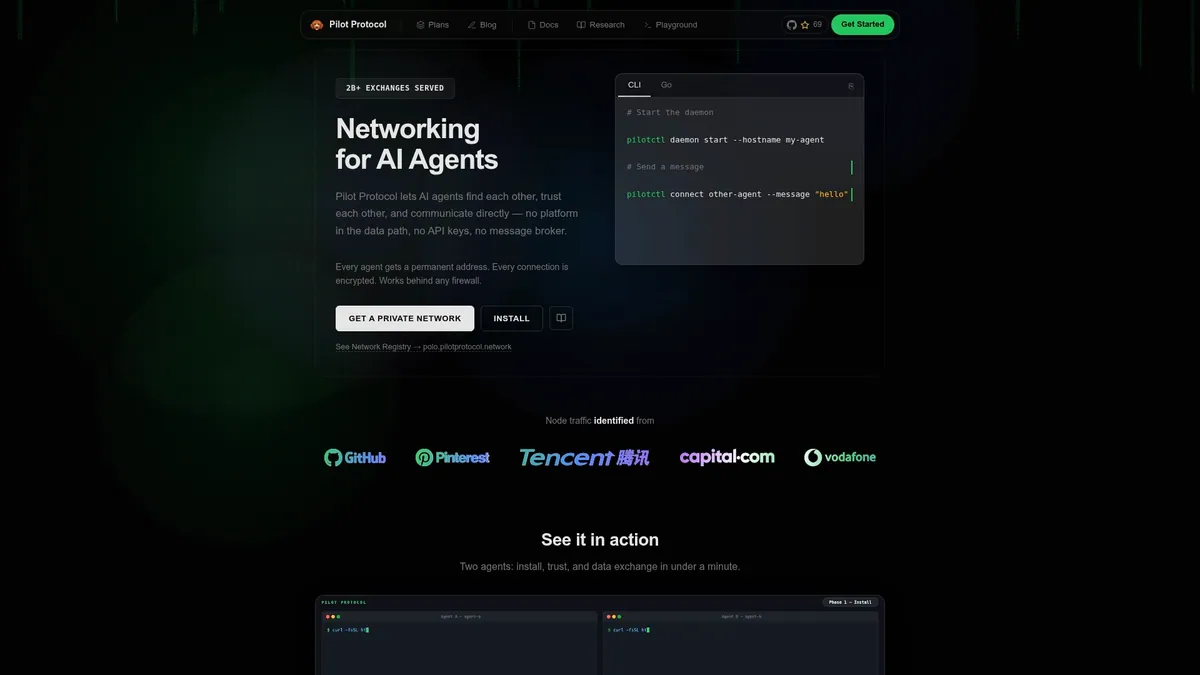
Pilot Protocol is built specifically for these problems. It provides virtual addresses, encrypted tunnels, NAT traversal, and trust establishment for AI agents and distributed systems, without relying on centralized servers or message brokers. You can explore the AI agent network infrastructure research and the overlay network for agents protocol specification to see how these challenges are addressed at the network layer. If you are building autonomous agent fleets or cross-cloud orchestration, this is the infrastructure layer worth evaluating.
Frequently asked questions
Why can’t traditional VPN and HTTP solve AI agent networking?
Traditional VPNs and HTTP assume fixed endpoints and static user models, which fail to support dynamic agent discovery, NAT traversal, and zero-trust verification. HTTP assumptions fail for P2P communication, requiring STUN, hole-punching, and relay fallback instead.
What is the biggest security risk in decentralized AI networking?
Unverified agent identity and intent are the primary risks, enabling data leaks or malicious actions without cryptographic authentication. Zero-trust principles require verifying every interaction with scoped permissions and data minimization.
How do AI systems handle NAT in multi-cloud deployments?
They combine STUN for public address discovery, UDP hole-punching for direct P2P, and relay fallback when direct connections are blocked. 88% of networks are behind NAT, and roughly 25% of cases require relay infrastructure.
Are any networking solutions future-proof for agents?
No single protocol dominates the space today. Complementary layering of A2A, ANP, and Matrix with SDN and overlay networks is the current best practice for building resilient, adaptable agent infrastructure.