
Advanced network automation: 7 tips for secure AI systems

Scaling secure, decentralized communication across multi-agent AI systems is one of the hardest infrastructure challenges you will face. The number of architectures, tools, and competing best-practice recommendations creates real decision fatigue. You need a clear path from criteria to implementation. Modular, reusable scripts with version control, parameterization, and rigorous testing form the foundation, but that is only the start. This article walks you through seven expert strategies, from defining automation goals to deploying Intent-Based Networking, so you can build agent fleets that are fast, resilient, and secure.
Table of Contents
- Define your automation goals and criteria
- Adopt modular and reusable automation scripts
- Leverage API-driven network automation tools
- Utilize Network Source of Truth (NSoT) for data consistency
- Accelerate automation with model-driven interfaces and benchmarks
- Implement autonomous remediation pipelines with ML monitoring
- Move towards Intent-Based Networking for secure, distributed cloud environments
- Build your secure agent network with Pilot Protocol
- Frequently asked questions
Key Takeaways
| Point | Details |
|---|---|
| Modular scripts are essential | Reusable, parameterized scripts minimize errors and optimize scaling in automation workflows. |
| APIs drive secure communication | API-based tools like REST and gRPC enable robust, secure agent-to-agent automation. |
| Model-driven automation is faster | NETCONF and similar interfaces deliver dramatically improved speed versus CLI for large-scale networks. |
| Autonomous pipelines reduce downtime | ML-enabled remediation pipelines cut fault resolution time by over 70 percent. |
| Intent-Based Networking streamlines policy | IBN converts business goals into automated policies for assurance in distributed cloud environments. |
Define your automation goals and criteria
Before you write a single line of automation code, you need clear goals. Vague objectives produce brittle networks. Start by identifying your core technical and business outcomes.
Key criteria to define upfront:
- Scalability: How many agents will the network support in 12 months?
- Security: What trust model governs agent-to-agent communication?
- Fault tolerance: What is your acceptable recovery time for a failed node?
- Vendor diversity: Are you managing a single-vendor stack or a multi-vendor environment?
One of the most important architectural decisions is centralized versus decentralized control. Centralized automation gives you a single point of visibility but creates a single point of failure. Decentralized automation improves resilience but adds coordination complexity. Multi-agent architectures replace centralized control with distributed agents for RAN autonomy, blocking unsafe policies and improving resilience across the full data collection-to-assurance pipeline.
For multi-agent network design, a hybrid approach often works best. You keep a lightweight central policy engine for compliance and trust verification while letting agents operate autonomously within defined boundaries.
“The goal is not full autonomy or full control. It is the right balance between the two, enforced by policy.”
Pro Tip: Use hybrid architectures that combine a central policy registry with decentralized agent execution. This gives you auditability without sacrificing resilience.
Adopt modular and reusable automation scripts
With clear criteria established, the next step is scripting for reliability and scalability. Monolithic scripts are the enemy of scale. When one function breaks, everything breaks. Modular scripts isolate failures and make testing far easier.
Core scripting best practices:
- Parameterization: Replace hardcoded values with variables. This makes scripts reusable across environments without modification.
- Error handling: Every function should fail gracefully and log the failure with enough context to diagnose it.
- Version control: Store all scripts in Git. Tag releases. Never run unreviewed code in production.
- Logging: Structured logs (JSON format preferred) make automated parsing and alerting straightforward.
- Dry-run mode: Build a simulation flag into every script so you can validate logic before applying changes.
Best practices for network automation scripts confirm that modularity, version control, and rigorous testing are non-negotiable for maintainable, scalable workflows. Peer reviews before merging automation scripts catch logic errors that dry-runs miss.

For teams building rapid multi-agent network setup, modular scripts also mean you can swap out individual components as your agent topology evolves without rewriting the entire automation layer.
Pro Tip: Encrypt all secrets at rest and in transit. Restrict script execution privileges using role-based access control. Never store API keys or credentials in script files, even in private repositories.
Leverage API-driven network automation tools
After mastering scripting, the next layer is powerful automation tools built for distributed environments. Modern network automation runs on APIs. REST, gRPC, and YANG model-driven interfaces give you programmatic control over every layer of your network stack.
Here is a comparison of the most widely used tools:
| Tool | Primary use | Best for |
|---|---|---|
| Ansible | Configuration management | Multi-vendor, agentless setups |
| Terraform | Infrastructure provisioning | Cloud-native, declarative workflows |
| Nornir | Python-native automation | Custom, high-performance scripting |
| Nautobot | Network source of truth + automation | GitOps and data-driven pipelines |
API-driven architectures using REST, gRPC, and YANG enable secure, scalable configuration management and GitOps integration across distributed environments. The right tool depends on your system complexity and vendor diversity. For homogeneous cloud environments, Terraform excels. For mixed-vendor physical and virtual networks, Ansible or Nornir gives you more flexibility.
For teams running encrypted pipeline automation, gRPC is particularly valuable because it supports bidirectional streaming and strong typing, which reduces protocol mismatch errors between agents.
Utilize Network Source of Truth (NSoT) for data consistency
Tooling aside, maintaining data consistency across a distributed network is foundational for automation success. Without a single authoritative data source, configuration drift becomes inevitable.
NSoT tools like Nautobot or NetBox serve as the canonical record for your network state. Every automation workflow reads from and writes back to the NSoT, ensuring that what you intend and what is deployed stay aligned.
NSoT is foundational for scalable automation, enabling data consistency, API access, and orchestration integration in multi-vendor setups.
How to integrate NSoT into distributed architectures:
- Inventory all network assets in the NSoT before writing any automation.
- Define data models for each device type, interface, and policy object.
- Connect your automation tools (Ansible, Terraform, Nornir) to pull live data from the NSoT via API.
- Enable event-driven triggers so that changes in the NSoT automatically kick off validation and deployment workflows.
- Run continuous validation to compare intended state (NSoT) against actual device state and alert on drift.
NSoT data consistency metrics:
| Metric | Without NSoT | With NSoT |
|---|---|---|
| Configuration drift incidents | High | Near zero |
| Audit preparation time | Days | Hours |
| Multi-vendor change success rate | ~70% | 95%+ |
For NSoT-driven automation workflows, the key is treating your NSoT as a live API, not a static spreadsheet. Query it programmatically on every run.
Accelerate automation with model-driven interfaces and benchmarks
For those seeking optimal speed and easy scaling, interface choice matters more than most engineers realize. The performance gap between model-driven interfaces and traditional CLI is not marginal.
NETCONF is 3x faster than MD-CLI and 11x faster than classic CLI in automated testing execution time for IP/MPLS networks. Automated topology creation runs 4.5x faster than manual processes using model-driven approaches.
Here is how the interfaces compare:
| Interface | Relative speed | Structured data | Error handling |
|---|---|---|---|
| Classic CLI | 1x (baseline) | No | Manual parsing |
| MD-CLI | ~3.7x | Partial | Improved |
| NETCONF/YANG | ~11x | Yes | Programmatic |
The practical recommendation: start with NETCONF for any new automation project targeting distributed cloud environments. Integrate it into your DevOps pipeline from day one. For legacy devices that only support CLI, use a translation layer (like Nornir with TextFSM) to normalize output into structured data before processing.
For zero trust automation environments, model-driven interfaces also simplify policy enforcement because every configuration change is structured, validated, and auditable before it reaches the device.
Implement autonomous remediation pipelines with ML monitoring
Fast detection is critical, but detection without automated resolution still wakes up your on-call engineer at 3 a.m. Autonomous remediation pipelines close that gap.
The detect-diagnose-act model structures your pipeline into three clear stages:
- Detect: ML anomaly detection monitors telemetry streams in real time, flagging deviations from baseline behavior.
- Diagnose: Automated root cause analysis correlates events across agents and network layers to identify the fault source.
- Act: Pre-approved remediation playbooks execute automatically, such as resetting a BGP session or rerouting traffic around a flapping link.
Autonomous remediation pipelines reduce MTTR by 72% for common faults like flapping links and BGP resets using ML anomaly detection and closed-loop assurance.
That 72% MTTR reduction is not theoretical. It comes from production deployments where the pipeline handles the full cycle without human intervention for well-defined fault classes.
For private agent remediation networks, you can scope remediation playbooks to specific agent groups, ensuring that automated actions never cross trust boundaries between isolated network segments.
Move towards Intent-Based Networking for secure, distributed cloud environments
The next frontier is intent-driven orchestration. Intent-Based Networking (IBN) translates high-level business policies into network configurations automatically, using AI and ML to maintain compliance continuously.
Key components of IBN for multi-agent, distributed environments:
- Intent translation: Business rules (“all agent traffic between regions must be encrypted”) become network policies automatically.
- Closed-loop assurance: The system continuously validates that the deployed state matches the intended state and remediates drift without manual input.
- AI/ML policy engine: Learns from historical traffic patterns to optimize policy application and predict compliance violations before they occur.
- Multi-cloud support: Applies consistent policies across AWS, GCP, Azure, and on-premises environments from a single intent definition.
IBN translates high-level business intent to policies via AI/ML, enables closed-loop automation and assurance, and is well suited for secure distributed cloud environments.
For cross-company agent collaboration without shared infrastructure, IBN is particularly powerful. You define the intent once, and the system enforces it consistently regardless of which cloud or region the agent is operating in.
Build your secure agent network with Pilot Protocol
Every strategy in this article, from modular scripting to IBN, depends on one thing: a reliable, secure communication layer between your agents. That is exactly what Pilot Protocol provides.
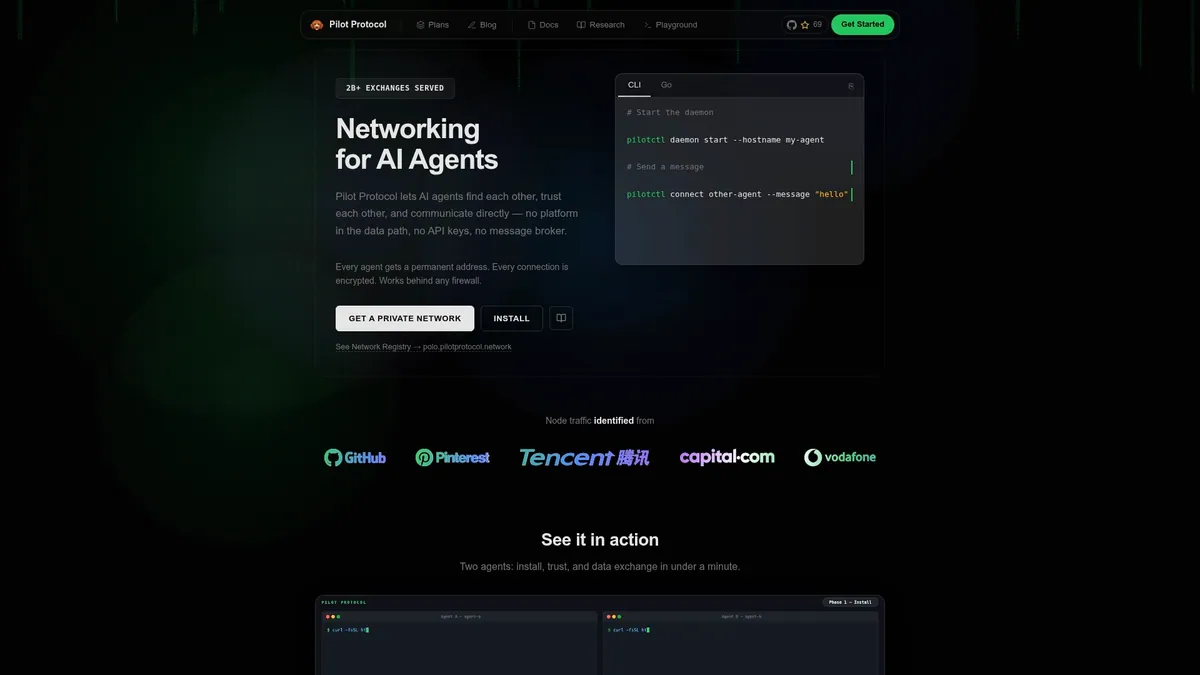
Pilot Protocol gives your AI agents persistent virtual addresses, encrypted tunnels, and NAT traversal across clouds and regions. It prefers direct peer paths and uses ciphertext relay fallback when a direct path cannot be established. It wraps gRPC, HTTP, and SSH inside its overlay, so existing automation tools can connect without rearchitecting the stack. Mutual trust establishment and multi-cloud connectivity provide a practical foundation for remediation pipelines, NSoT-driven workflows, and cross-region agent fleets.
Frequently asked questions
What is the most secure way to automate communication between AI agents?
Use gRPC or REST APIs with encrypted channels and apply a zero trust framework that verifies every agent identity before allowing communication. Mutual TLS and token-based authentication are the minimum baseline.
How can distributed networks prevent unsafe actions from agents?
Multi-agent architectures with policy verification and trust-aware communication block unsafe policies at the architecture level. Combine decentralized agent execution with a central policy registry for hybrid oversight.
What’s the impact of model-driven APIs on automation speed?
Model-driven interfaces like NETCONF are 10 to 11 times faster than classic CLI for large-scale automated testing and topology creation, making them the clear choice for high-volume distributed environments.
How does NSoT improve automation in multi-vendor environments?
NSoT provides a unified data source that eliminates configuration drift and supports scalable orchestration via APIs, ensuring every automation tool works from the same authoritative network state.
Can ML-enabled remediation pipelines be set up for private agent networks?
Yes. Using a detect-diagnose-act model with ML anomaly monitoring, private agent networks can automate rapid fault resolution while keeping remediation actions scoped within defined trust boundaries.