Mastering multi-cloud networking for decentralized AI systems

TL;DR:
- Multi-cloud AI agent networks are shifting from VPNs to application-layer overlays for better security and flexibility.
- Agent-centric overlays enable direct, secure, and scalable communication across clouds without manual configuration.
- Overlay protocols like Pilot Protocol facilitate autonomous, cost-effective, and resilient multi-cloud agent connectivity.
Most cloud infrastructure engineers assume that securing multi-cloud environments for AI agents means deploying a maze of VPN gateways, proprietary connectors, and expensive private circuits. That assumption is increasingly wrong. Secure connectivity across AWS, Azure, and GCP is achievable through multiple models, including IPsec VPN, private interconnects, and SD-WAN overlays, but a newer class of agent-aware overlay networks is changing the calculus entirely. This guide covers the core connectivity models, the rise of agent-centric overlays, real-world design trade-offs, and how to build resilient, secure multi-cloud networks for autonomous agent fleets without over-engineering your infrastructure.
Table of Contents
- Why multi-cloud networking matters for autonomous agents
- Core connectivity models: VPN, private interconnect, SD-WAN, and overlays
- Overlays and enclave designs: The agent-centric paradigm
- Architecting multi-cloud: Trade-offs, challenges, and best practices
- A new era: Why overlays, not classic networking, unlock AI autonomy
- Pilot Protocol: Powering the next generation of multi-cloud agent networks
- Frequently asked questions
Key Takeaways
| Point | Details |
|---|---|
| Decentralized overlays are essential | Agent-centric overlays deliver security, cost-efficiency, and autonomy beyond traditional VPNs in multi-cloud AI networks. |
| Hybrid architectures boost resilience | Combining overlays, SD-WAN, and private interconnects balances performance, management, and redundancy. |
| Vendor-neutral networking is the future | Open overlays and secure enclaves minimize lock-in, enabling rapid evolution of agent architectures. |
| Design for real-world limits | Careful planning avoids mesh explosion, non-transitive peering, and cloud interoperability bottlenecks. |
Why multi-cloud networking matters for autonomous agents
Autonomous AI agents do not stay in one cloud. They spawn across AWS Lambda, GCP Vertex AI, and Azure Container Apps, often within the same workflow. That distribution is intentional: you get best-of-breed services, geographic redundancy, and the ability to meet data residency requirements across jurisdictions. But it creates a hard networking problem.
Every agent-to-agent call that crosses cloud boundaries needs to be fast, authenticated, and encrypted. Traditional approaches, like site-to-site VPNs or dedicated private circuits, were designed for human-operated workloads with predictable traffic patterns. Autonomous agents are different. They spin up dynamically, communicate in bursts, and need to establish trust with peers they have never contacted before.
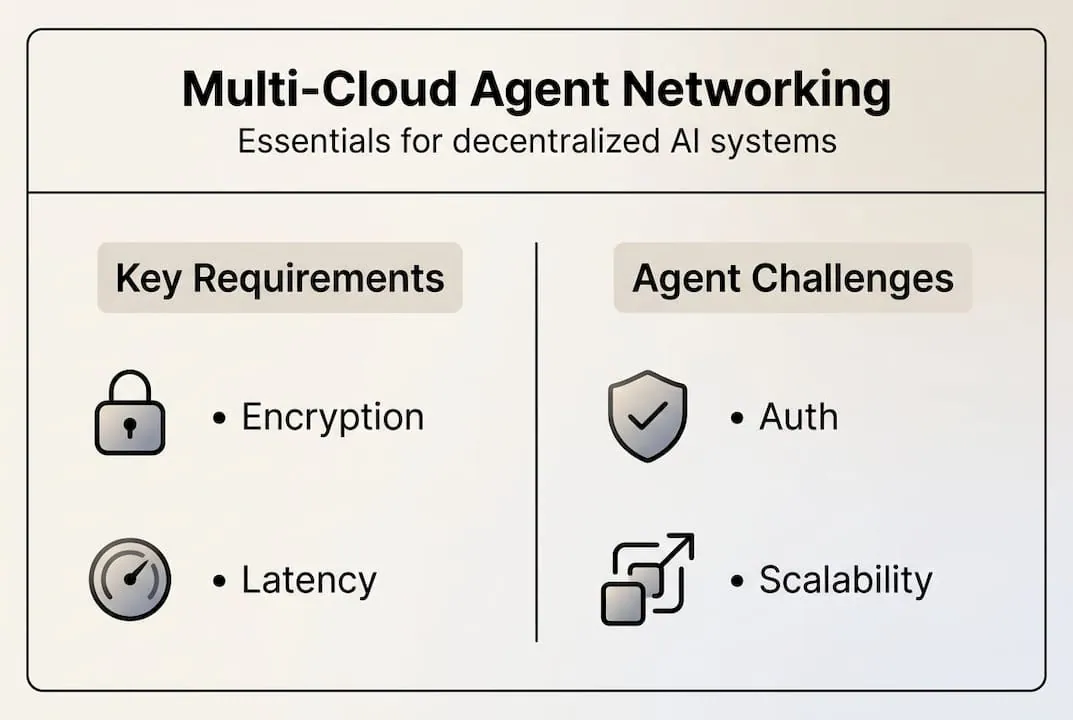
Multi-cloud connectivity models like IPsec VPN, private interconnects, and SD-WAN overlays each address part of this problem, but none were built with agent autonomy in mind. That gap is where service agent overlays fill in.
Here are the critical needs your multi-cloud agent network must satisfy:
- Interoperability: Agents must communicate across cloud vendors without protocol translation layers.
- Security: Every connection needs mutual authentication and end-to-end encryption, not just perimeter firewalls.
- Resilience: If one cloud region fails, agents must reroute automatically without manual intervention.
- Cost efficiency: Always-on VPN tunnels and dedicated circuits are expensive at agent scale. You need a model that scales down when agents are idle.
- Low operational overhead: Your team should not need to manage hundreds of tunnel configurations manually.
The shift from VPN-centric models to application-layer overlay protocols is not incremental improvement. It is a fundamental change in how agent communication is architected, moving trust and addressing from the network layer to the agent identity layer.
Understanding decentralized communication protocols helps you see why this shift matters. When agents carry their own identity and encryption keys, the network becomes a transport layer rather than a security boundary. That separation is what makes truly autonomous, cross-cloud agent systems possible.
Core connectivity models: VPN, private interconnect, SD-WAN, and overlays
Choosing the right connectivity model is one of the most consequential decisions you will make when architecting multi-cloud agent infrastructure. Each model has distinct performance characteristics, cost profiles, and operational demands.
Hybrid architectures combining VPN, private interconnects, and SD-WAN are common in production, with VPN handling backup paths, private interconnects serving high-throughput production traffic, and SD-WAN managing policy orchestration across both. Colocation exchanges like Equinix Fabric and Megaport enable efficient intercloud topologies by providing neutral interconnection points between cloud providers.
Performance data matters here, but provider-wide averages are a poor substitute for measurements along the paths your agents actually use. Benchmark inter-region latency, jitter, packet loss, and failover behavior for each candidate topology before choosing a control plane. For latency-sensitive agent workloads, those measurements directly affect task completion times.
| Model | Throughput | Latency | Cost | Best for |
|---|---|---|---|---|
| IPsec VPN | 1-10 Gbps | Medium | Low upfront | Backup paths, dev environments |
| Private interconnect | 10-100 Gbps | Low | High fixed cost | High-volume production traffic |
| SD-WAN overlay | Variable | Medium | Moderate | Policy management, orchestration |
| Agent overlay (e.g., Pilot Protocol) | Variable | Low to medium | Usage-based | Autonomous agent fleets |
Understanding overlay protocol fundamentals is essential before committing to any architecture. Overlays operate at the application layer, meaning they are cloud-agnostic by design and do not depend on cloud-provider-specific routing constructs.
Pro Tip: Use SD-WAN overlays for dynamic policy management when you need centralized control over routing decisions across multiple clouds. Pair them with agent-layer overlays for workloads that require per-agent identity and encryption rather than per-network policy.
The key insight is that no single model wins across all dimensions. Your architecture will likely combine two or three of these, with the agent overlay handling the identity and encryption layer that traditional models cannot provide.
Overlays and enclave designs: The agent-centric paradigm
Agent-centric overlays represent a different way of thinking about multi-cloud connectivity. Instead of building tunnels between networks, you build an identity fabric between agents. Each agent gets a persistent virtual address and cryptographic identity. The registry handles discovery; bilateral trust decisions are signed by the peers, while shared-network access remains governed by network membership policy.

Agent-specific overlays like Pilot Protocol use virtual addressing, NAT traversal, and end-to-end encryption without requiring VPN gateways. That means no always-on tunnel costs, no manual firewall rules, and no dependency on cloud-provider networking primitives.
Secure agent enclaves extend this further by creating zero-trust communication zones where agents authenticate each other before exchanging any data. Mesh topologies within enclaves allow agents to communicate directly rather than routing through a central broker, which reduces latency and eliminates single points of failure.
Here are the core benefits of adopting an agent overlay architecture:
- Resilience: Mesh topologies mean no single node failure breaks agent communication.
- Cost reduction: No persistent VPN gateway fees. Agents connect on demand.
- Scalability: Adding a new agent to the network requires no firewall rule changes or tunnel provisioning.
- Autonomy: Agents discover and verify peers independently using cryptographic identity.
- Vendor independence: The overlay runs above cloud networking, so you can migrate workloads between clouds without reconfiguring connectivity.
| Solution | Monthly cost (est.) | Latency | Scalability |
|---|---|---|---|
| VPN gateway (per tunnel) | $150-400+ | Medium | Low (manual) |
| Private interconnect | $500-2000+ | Low | Medium |
| Agent overlay (Pilot Protocol) | Usage-based | Low to medium | High (automatic) |
Pro Tip: Use overlays to avoid mesh explosion. When you have 50 or more agents across three clouds, point-to-point VPN tunnels become unmanageable. An overlay with virtual addressing handles peer discovery and routing automatically, cutting operational complexity significantly.
For teams building zero trust agent communication, the enclave model is the right starting point. It gives you a clean security boundary without the operational burden of managing network-layer ACLs across multiple cloud providers. Refer to the secure agent network guide for a practical implementation walkthrough.
Architecting multi-cloud: Trade-offs, challenges, and best practices
Knowing the models is one thing. Building a production system that survives real-world conditions is another. Multi-cloud agent networks have specific failure modes that you need to design around from day one.
AWS Transit Gateway has regional limits, Azure vWAN offers less route control, and GCP NCC is still maturing. Non-transitive VPC peering is a common trap: two VPCs peered to a hub do not automatically gain connectivity to each other. All-or-nothing VPN configurations create fragility when one endpoint goes down.
Here is a step-by-step design process for resilient agent networking:
- Map your agent communication patterns first. Understand which agents talk to which, how often, and what data volumes are involved before choosing a connectivity model.
- Segment by trust boundary, not by cloud. Group agents by function and sensitivity, not by which cloud they run on. This simplifies your zero-trust policy.
- Choose your primary and backup paths explicitly. Do not rely on cloud-provider defaults for failover. Define routing policies that match your latency and cost requirements.
- Use overlays for agent-to-agent traffic, private interconnects for bulk data. Mixing models based on traffic type reduces cost without sacrificing performance.
- Automate certificate and key rotation. Manual key management at agent scale is a security liability. Build rotation into your CI/CD pipeline from the start.
- Monitor per-agent connectivity, not just network health. An agent that cannot reach its peers is a problem even if your network metrics look healthy.
Expert guidance consistently points to AWS TGW for fine-grained control, Azure vWAN for large-scale hub-and-spoke deployments, and GCP for latency-sensitive workloads. SD-WAN unifies policy across all three. Engineers with cross-cloud networking expertise command significantly higher salaries, reflecting how rare and valuable this skill set is.
Most production deployments require a hybrid approach. No single cloud networking product covers all the edge cases. Plan for constant policy review as your agent fleet grows and cloud providers update their networking primitives.
Addressing AI networking challenges early in your design process saves significant rework later. And securing agent networks across clouds requires treating security as an architectural property, not a feature you add after deployment. Review agent enclave best practices to see how leading teams are handling this in 2026.
A new era: Why overlays, not classic networking, unlock AI autonomy
Here is what most architecture discussions miss: the fundamental problem with applying classic networking models to autonomous agent systems is not performance or cost. It is the wrong abstraction.
Traditional network-centric models treat connectivity as infrastructure that humans configure and agents use. Agent-centric overlays invert that. The agent carries its identity, its trust relationships, and its routing logic. The network becomes a dumb transport layer. That inversion is what enables true autonomy.
Application-layer overlays decouple agents from cloud networking complexity, enabling decentralized secure communication without vendor lock-in. That means your agents can migrate between clouds, survive cloud-provider outages, and establish new peer relationships without waiting for a network engineer to update a routing table.
Most teams underinvest in overlay and agent networking expertise. They spend months optimizing VPN configurations that will need to be replaced anyway as their agent fleet scales. The teams that get ahead are the ones building secure protocols for distributed AI into their architecture from the start, not retrofitting them later.
Layered overlays with identity-based communication will define the next decade of multi-cloud AI infrastructure. The teams that recognize this now will build systems that are faster to deploy, cheaper to operate, and significantly easier to secure.
Pilot Protocol: Powering the next generation of multi-cloud agent networks
If you are ready to evaluate an alternative to VPN-centric agent networking across AWS, GCP, and Azure, Pilot Protocol provides virtual addressing, NAT traversal, peer trust, and encrypted tunnels. Direct paths are preferred, with encrypted relay fallback; operators retain responsibility for application authorization and production validation.
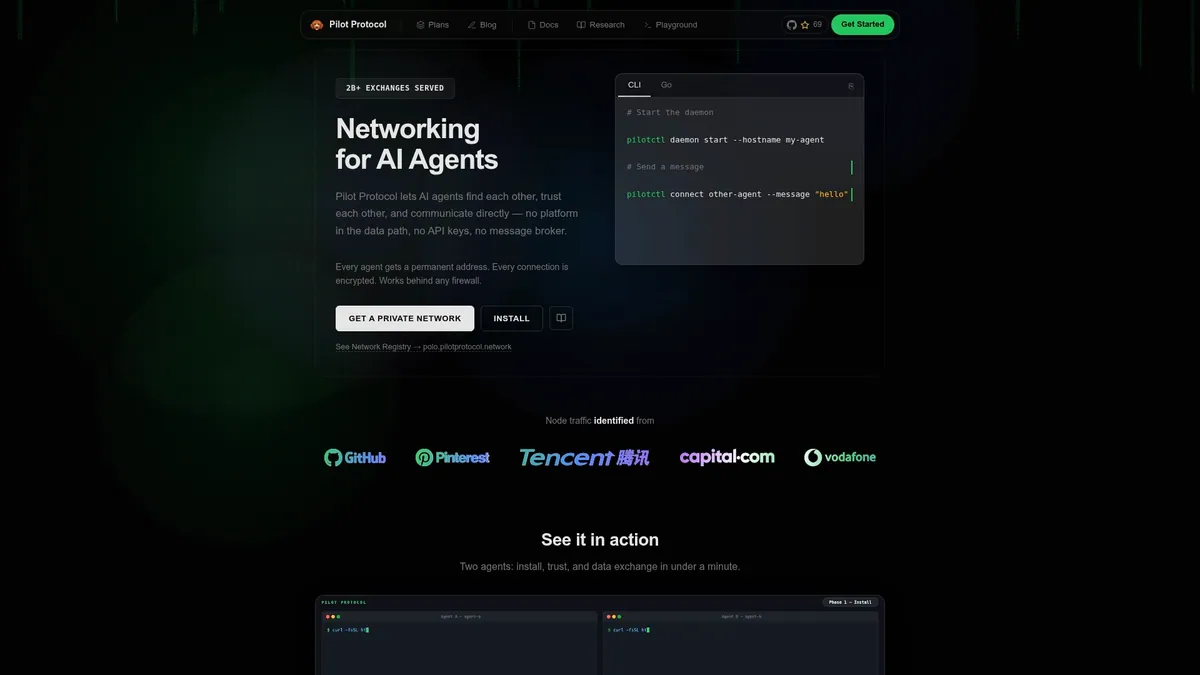
Pilot Protocol wraps your existing HTTP, gRPC, and SSH traffic inside a secure overlay, which means you can integrate it with your current stack without rewriting your agent communication logic. Explore the Pilot Protocol overlay network specification to understand how it works under the hood, and start testing your own multi-cloud agent connectivity today.
Frequently asked questions
What are the main benefits of multi-cloud networking for AI agent systems?
Multi-cloud networking gives AI agents secure, reliable, and cost-efficient communication across the best clouds, increasing autonomy and reducing downtime. It also prevents vendor lock-in and enables data residency compliance across regions.
How do overlays like Pilot Protocol reduce costs compared to VPNs?
Agent overlays eliminate VPN gateway fees and tunnel sprawl by using application-layer logic and direct agent addressing, so you only pay for what your agents actually use. There are no always-on tunnel costs or manual provisioning overhead.
What are common challenges when building multi-cloud agent networks?
Engineers frequently encounter non-transitive VPC peering limits, routing policy complexity, and integration friction between overlays and legacy infrastructure. Careful upfront design and automated key management reduce most of these risks.
Are overlays and enclave networks secure enough for sensitive AI workloads?
Zero-trust agent enclaves use identity-based mutual authentication and end-to-end encryption, meeting or exceeding the security guarantees of classic VPN architectures. For sensitive workloads, the per-agent identity model is actually stronger than perimeter-based approaches.