Secure network infrastructure for AI agents: A practical guide
Most enterprise IT teams assume their existing network stack, firewalls, VPNs, and centralized brokers can handle AI agent communications with minor adjustments. That assumption is wrong, and it’s costing teams real time and security exposure. AI agents operate differently from traditional services. They need to discover peers dynamically, negotiate trust on the fly, and exchange data across cloud boundaries without a human in the loop. Legacy infrastructure was never designed for this. This guide covers the core protocols, architectural patterns, and practical frameworks you need to build secure, decentralized network infrastructure for autonomous agent fleets in 2026.
Table of Contents
- Why AI agents need specialized network infrastructure
- Core protocols: A2A, ANP, and standardization for agent interoperability
- Decentralized communication: Architectures, routing, and edge challenges
- Practical applications: Multi-cloud orchestration, security, and agent coordination
- The uncomfortable truth about agent network infrastructure: Lessons from 3 years in production
- Take the next step: See Pilot Protocol for agent networks
- Frequently asked questions
Key Takeaways
| Point | Details |
|---|---|
| Legacy stacks fall short | Traditional enterprise networking is not equipped for agent-to-agent orchestration or cross-cloud reliability. |
| A2A protocol leads innovation | A2A sets the standard for secure, interoperable AI agent communication, powering enterprise adoption. |
| Decentralized architectures drive resilience | Mesh topologies and store-and-forward routing improve scalability, security, and offline robustness. |
| Multi-cloud orchestration made easy | Agents can coordinate securely across cloud providers without VPNs using modern protocols. |
| Solution frameworks are available | Purpose-built stacks like Pilot Protocol support secure, scalable infrastructure for agent networks. |
Why AI agents need specialized network infrastructure
Traditional enterprise networking was built for predictable, human-initiated traffic. A user opens a browser, a request goes to a server, a response comes back. AI agents break this model completely. They initiate connections autonomously, form dynamic meshes with other agents, and operate across regions and clouds without a fixed topology.
Understanding why agents need network stacks that go beyond conventional tooling is the first step. Here is what makes agent networking fundamentally different:
- Dynamic peer discovery: Agents must find and verify other agents at runtime, not through static DNS or IP tables.
- Mutual authentication: Every agent-to-agent connection requires bidirectional trust, not just server-side certificates.
- Low-latency coordination: Real-time task delegation across agents requires sub-second signaling, which centralized brokers introduce latency into.
- Multi-cloud routing: Agents deployed on AWS, GCP, and Azure need direct paths, not backhaul through a corporate data center.
- Autonomous operation: Agents must handle network failures, retries, and rerouting without human intervention.
Legacy stacks simply can’t handle secure multi-agent orchestration effectively. VPNs require static configuration. Firewalls block dynamic peer connections. Centralized message brokers create single points of failure and latency bottlenecks.
“The core challenge is not connectivity. It is trust, discovery, and coordination at machine speed across environments that were never designed to interoperate.”
Research into AI networking challenges in decentralized systems confirms this gap. Even well-funded teams hit walls when they try to retrofit enterprise stacks for agent workloads. Benchmarks like AGENTSNET test coordination between agents but do not evaluate the underlying network infrastructure at all. That gap in tooling and measurement reflects how early this space still is.
The risks are real. Without proper agent-to-agent security controls, you expose task payloads, model outputs, and internal API calls to interception. Without decentralized routing, you create bottlenecks that collapse under load. Getting the infrastructure right from the start is not optional.
Core protocols: A2A, ANP, and standardization for agent interoperability
Two protocols are shaping how agents communicate in 2026: A2A (Agent2Agent Protocol) and ANP (Agent Network Protocol). They take different approaches, and choosing between them has real consequences for your architecture.
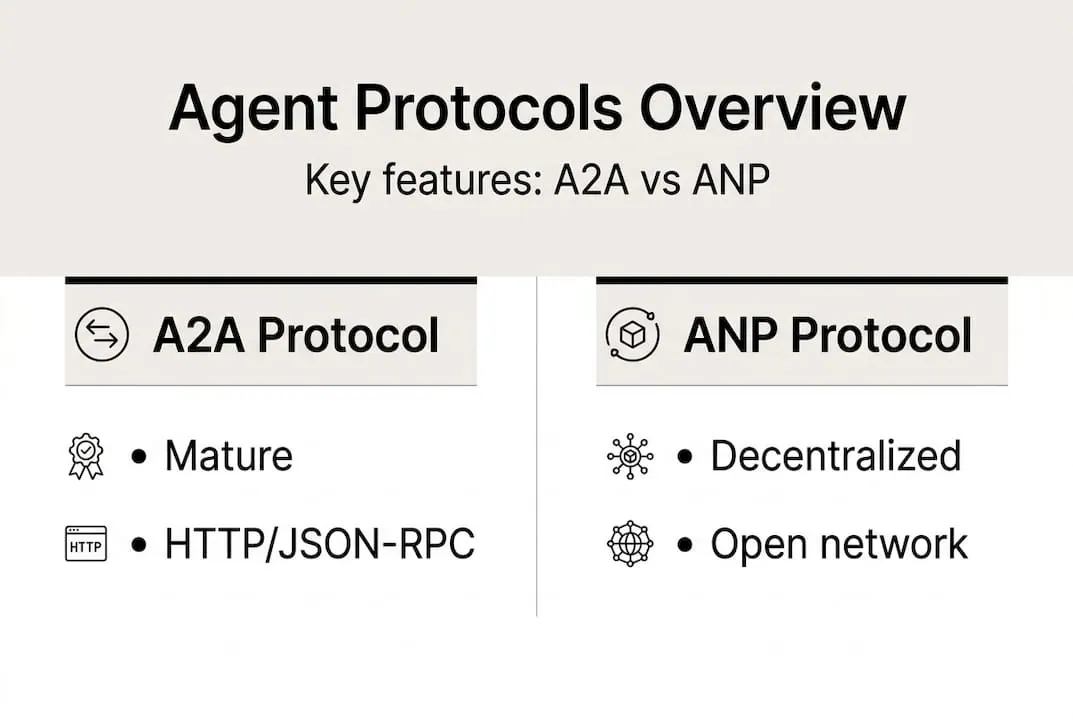
A2A protocol is the production-ready standard. Built on HTTP and JSON-RPC, it defines a structured way for agents to advertise capabilities via Agent Cards, manage task lifecycles, and exchange results securely. The A2A protocol is the leading standardized method for secure agent-to-agent communication, and it has 150+ production partners already using it at scale.
Here is how a typical A2A interaction flows:
- Agent Card publication: The provider agent publishes a JSON Agent Card describing its capabilities, endpoints, and authentication requirements.
- Discovery: The consumer agent queries a known registry or well-known URL to retrieve the Agent Card.
- Task submission: The consumer sends a structured task request via JSON-RPC over HTTPS.
- Lifecycle management: The provider updates task state (submitted, working, completed, failed) and streams results back.
- Result delivery: The consumer receives the final output and updates its own state machine.
ANP takes a more open, decentralized vision. It aims to enable agents to find and interact with any other agent on an open web, without centralized registries. However, ANP is still early-stage. See the decentralized protocols overview for a fuller comparison of both approaches.
| Feature | A2A | ANP |
|---|---|---|
| Maturity | Production-ready | Early-stage |
| Transport | HTTP/JSON-RPC | Decentralized/P2P |
| Discovery | Agent Cards + registry | Open web crawl |
| Partner adoption | 150+ | Limited |
| Best for | Enterprise production | Future open agent web |
For agent discovery protocols, A2A gives you a structured, auditable path today. ANP is worth monitoring for long-term architectural decisions.
Pro Tip: Use A2A for any production deployment where you need reliability and partner ecosystem support. Track ANP for future-proofing, but do not build critical workflows on it yet.
Decentralized communication: Architectures, routing, and edge challenges
Choosing a protocol is only half the problem. The network topology underneath it determines whether your agent fleet is resilient or fragile.
Mesh topologies allow every agent to connect directly to every other agent. This eliminates central bottlenecks and supports low-latency coordination. The tradeoff is connection management complexity, which grows quadratically with fleet size.
Hybrid topologies combine a lightweight coordination layer with direct agent-to-agent data paths. This balances manageability with performance and works well for most enterprise deployments.
The decentralized networking challenges that teams most often underestimate include:
- Offline routing: Agents in edge environments lose connectivity. Store-and-forward solutions like Indigo Mesh queue messages and deliver them when the connection restores.
- Circuit breakers: When a downstream agent fails, AgenticConnect circuit breakers prevent cascading failures by isolating the fault and rerouting tasks.
- Jurisdictional arbitration: Sovereign AI requirements mean some data cannot leave specific regions. Your routing layer must enforce these rules automatically.
- NAT traversal: Most agents sit behind NAT. Without explicit punch-through mechanisms, direct P2P connections fail silently.
| Challenge | Solution | Tradeoff |
|---|---|---|
| Offline agents | Store-and-forward (Indigo Mesh) | Delivery latency |
| Cascading failures | Circuit breakers (AgenticConnect) | Added complexity |
| Data sovereignty | Jurisdictional routing rules | Reduced flexibility |
| NAT traversal | P2P punch-through | Requires coordination layer |
For zero trust agent networking, every connection must be authenticated and encrypted regardless of network position. Do not assume that agents inside the same VPC or cloud region are trusted by default.
Pro Tip: Implement circuit breakers and store-and-forward from day one. Retrofitting resilience into a live agent fleet is significantly harder than building it in at the start.
Practical applications: Multi-cloud orchestration, security, and agent coordination
With the right protocols and topology in place, you can build agent systems that operate reliably across complex environments. Here are the most impactful use cases and how to approach them.
Multi-cloud orchestration without VPNs
Connecting agents across AWS, GCP, and Azure without VPNs is achievable using decentralized overlay networks and A2A-compatible endpoints. The key steps are:
- Assign each agent a persistent virtual address that is independent of its cloud-assigned IP.
- Use encrypted P2P tunnels for data exchange, with NAT traversal handled automatically.
- Register Agent Cards in a shared discovery layer accessible to all participating clouds.
- Apply routing policies that respect data residency requirements per region.
- Monitor agent health and task state from a unified control plane.
Privacy and security for regulated workloads
For healthcare agent communication, encrypted data paths, auditable task exchange, identity-based access control, administrative safeguards, and appropriate legal agreements all matter. Transport controls are only one part of the compliance program.
Agent discovery and coordination
Effective coordination depends on reliable discovery. Use structured Agent Cards to publish capabilities, and query them programmatically before task delegation. This avoids hardcoded endpoint lists that break when agents scale or migrate.
Key considerations for enterprise adoption:
- Start with a controlled pilot: deploy 5 to 10 agents using A2A before scaling.
- Validate your NAT traversal and encryption stack in each target cloud.
- Instrument every agent connection for latency, failure rate, and task throughput.
Importantly, there are no established benchmarks for decentralized AI agent network performance. You will need to define your own baselines. Use advanced network automation tips to build observability into your stack from the start, not as an afterthought.
The uncomfortable truth about agent network infrastructure: Lessons from 3 years in production
Here is what most vendor content will not tell you: the hardest part of agent networking is not the protocol choice. It is operational resilience under real-world conditions.
Teams spend months debating A2A versus ANP, then ship a fleet with no circuit breakers and no store-and-forward, and it collapses the first time a cloud region has a partial outage. Protocol maturity matters, and A2A’s 150+ production partners reflects genuine battle-testing. ANP is not ready for enterprise scale yet.
The second lesson is that no single topology fits every workload. A mesh works for small, latency-sensitive fleets. A hybrid approach scales better for large, geographically distributed deployments. Compliance requirements often dictate topology more than performance does.
The third lesson is about observability. You cannot debug what you cannot see. Every agent connection, task delegation, and routing decision needs a log entry. Teams that skip this step spend weeks diagnosing failures that would have taken hours with proper instrumentation.
For teams scaling agent fleets to thousands of nodes, the infrastructure decisions you make at 10 agents will either support or constrain you at 10,000. Build for resilience and observability first. Optimize for performance second.
Take the next step: See Pilot Protocol for agent networks
Building secure, decentralized agent networks is complex, but you do not have to start from scratch. Pilot Protocol provides a dedicated network stack built specifically for AI agent communications, with persistent virtual addresses, encrypted P2P tunnels, NAT traversal, and mutual trust establishment built in.
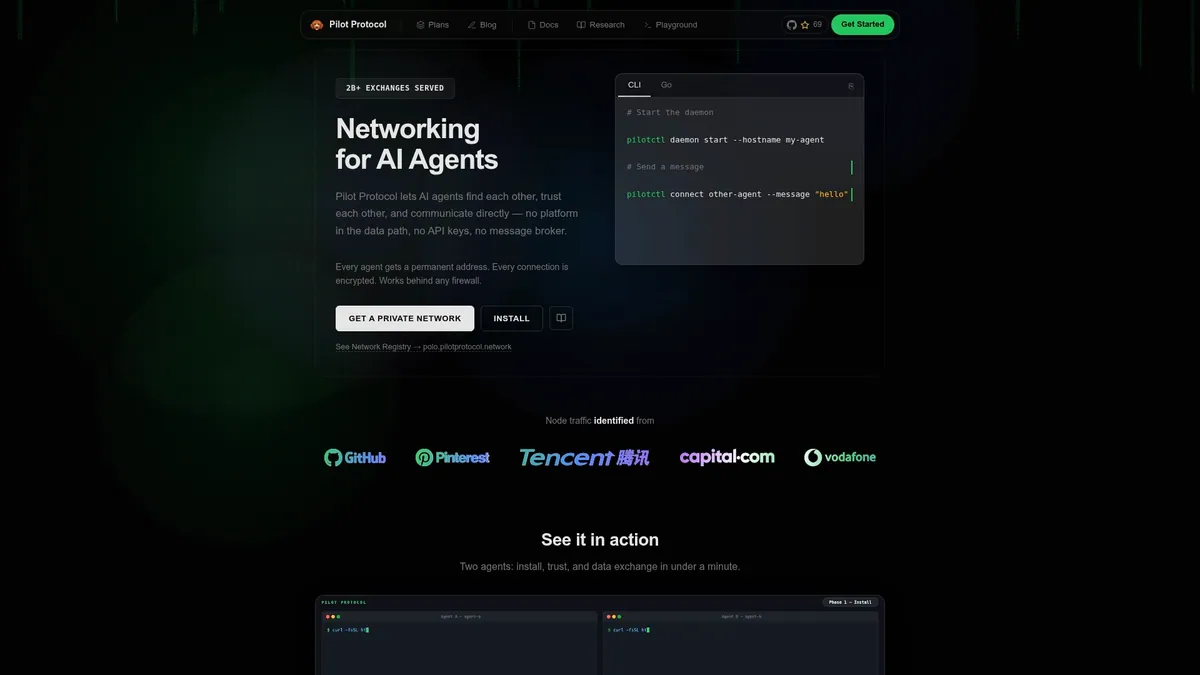
The Pilot Protocol problem statement maps to the challenges covered in this guide: dynamic discovery, multi-cloud routing, and agent coordination without a workflow-specific broker. The public backbone can be evaluated with the CLI or SDKs; managed private and enterprise deployments remain early access.
Frequently asked questions
What is the A2A protocol and why is it important for AI agent networks?
A2A (Agent2Agent Protocol) is a standardized method for secure agent communication, capability discovery, and task lifecycle management. It is adopted by over 150 partners and is the most mature option for production-scale agent deployments today.
How do decentralized network architectures improve agent scalability and security?
Decentralized architectures like mesh and store-and-forward routing enable scalable, resilient agent communication while eliminating single-point failures and supporting offline operation in edge environments.
Can agents coordinate across multiple clouds without traditional VPNs?
Yes. Standardized protocols and decentralized overlay networks let agents discover and communicate across clouds like AWS, GCP, and Azure without VPNs, reducing complexity and improving routing flexibility.
Are there empirical benchmarks for decentralized agent network performance?
Currently, no established benchmarks exist for decentralized agent networks. AGENTSNET tests agent coordination logic only, not the underlying network infrastructure performance.