
Network tunnels in AI: Secure comms for autonomous agents

TL;DR:
- AI network tunnels are encrypted, protocol-aware channels designed for secure agent-to-tool communication.
- They rely on components like TLS, JSON-RPC, MCP gateways, and NAT traversal to ensure security and reliability.
- Proper implementation emphasizes Zero Trust, session verification, and monitoring to mitigate security risks.
Most engineers assume a network tunnel is just a VPN with a fancier name. In AI deployments, that assumption will cost you. Network tunnels in AI primarily refer to secure tunneling mechanisms used to expose local MCP servers to remote AI agents, not generic connectivity layers. They carry structured, protocol-aware traffic between autonomous agents and the tools they depend on in real time. This article covers the technical foundations, key components, security risks, and a practical implementation framework so you can deploy agent communication that actually holds up in production.
Table of Contents
- What is a network tunnel in AI?
- Key components of network tunneling for AI agents
- Security risks and best practices
- Implementing network tunnels for agentic AI systems
- Why secure network tunnels are redefining agentic AI architectures
- Take the next step: Secure agent networking with Pilot Protocol
- Frequently asked questions
Key Takeaways
| Point | Details |
|---|---|
| AI tunnels enable secure tool access | Network tunnels in AI let remote agents access local MCP servers safely and efficiently. |
| Zero Trust is essential | Security for agentic AI depends on traffic inspection and isolation, not just encryption. |
| Understand modern protocols | Protocols like JSON-RPC 2.0 and SSE are central to tunnel reliability and agent compatibility. |
| Beware emerging risks | Shadow IT and protocol attacks can undermine agent reliability if not actively mitigated. |
What is a network tunnel in AI?
A network tunnel in the AI context is an encrypted pathway that connects an AI agent to a remote tool or data resource. It is not a general-purpose VPN. It is a purpose-built channel designed to carry structured, application-level messages between agents and services, often across firewalls, NAT boundaries, and cloud regions.
The clearest example is the Model Context Protocol. MCP is an open JSON-RPC 2.0 protocol that lets AI agents access tools and resources over a client-server model. When your MCP server runs locally but your agent runs in a cloud environment, a tunnel bridges that gap. Without it, the agent simply cannot reach the tool.
Here is how AI tunnels differ from traditional approaches:
| Feature | Traditional VPN | AI Network Tunnel |
|---|---|---|
| Primary purpose | Generic network access | Agent-to-tool communication |
| Protocol awareness | None | JSON-RPC, SSE, HTTP |
| Security model | Perimeter-based | Zero Trust, per-session |
| Latency sensitivity | Low | High (real-time agent calls) |
| Inspection capability | Minimal | Full protocol inspection |
Network tunnels bridge local MCP servers to remote AI agents, enabling workflows that would otherwise require exposing services publicly or relying on fragile port forwarding rules.
Why does this matter for your deployments? Consider these core reasons:
- Real-time tool access: Agents make synchronous calls to tools. Latency and reliability are not optional.
- Structured message integrity: JSON-RPC payloads must arrive intact and unmodified.
- Secure exposure: Local dev servers or internal APIs should never be exposed to the public internet without encryption and access control.
- Cross-environment reach: Agents in cloud environments need to reach tools running on-premise or in other clouds.
The encrypted tunnel advantages for peer-to-peer AI networks go well beyond what traditional VPNs offer. You get per-session encryption, protocol-level inspection, and identity-aware access control built into the channel itself.
Pro Tip: If your MCP server is running on localhost during development, use a tunnel with TLS termination and token-based authentication before exposing it to any remote agent, even in a staging environment.
Key components of network tunneling for AI agents
Understanding the purpose of a tunnel is step one. Knowing what it is made of helps you build and operate it correctly.
Every effective AI agent tunnel relies on a specific stack of technologies working together. Here are the core components:
- Transport protocol layer: JSON-RPC 2.0 is the message format. The transport can be stdio (for local processes), SSE (Server-Sent Events for streaming responses), or HTTP for standard request-response patterns. Your choice depends on the agent’s latency needs and the tool’s capabilities.
- Encryption layer: TLS 1.3 is the baseline. Every tunnel carrying agent traffic should enforce mutual TLS (mTLS) where both sides present certificates. This prevents man-in-the-middle attacks on the message stream.
- MCP Gateway: This is the inspection and control plane. A gateway sits between the agent and the tunnel endpoint, parsing JSON-RPC messages, enforcing access policies, and blocking malformed or malicious payloads before they reach your tools.
- NAT traversal mechanism: Most production environments sit behind NAT. Your tunnel solution needs reliable punch-through or relay capabilities to maintain stable connections across network boundaries.
- Identity and authentication: Each agent session should carry a verifiable identity token. This enables per-agent access control and audit logging at the tunnel level.
The scale of MCP adoption makes this architecture critical. Over 500 public MCP servers exist as of 2026, with support from Claude, Cursor, OpenAI, and Google. Every one of those integrations depends on a reliable, secure tunnel to function in production.
| Component | Role | Example Technology |
|---|---|---|
| Transport | Carries structured messages | SSE, HTTP, stdio |
| Encryption | Protects data in transit | TLS 1.3, mTLS |
| Gateway | Inspects and controls traffic | MCP Gateway, reverse proxy |
| NAT traversal | Maintains connectivity | STUN, TURN, P2P punch-through |
| Identity | Authenticates agent sessions | JWT, API keys, certificates |
For teams running agents across multiple cloud providers, the ability to connect agents across AWS, GCP, Azure without a VPN is a major operational advantage. You also need secure network infrastructure that scales with your agent fleet, not just your traffic volume.

Security risks and best practices
Tunnels open powerful capabilities. They also open new attack surfaces. You need to know both sides.
The most common vulnerabilities in AI agent tunneling include:
- Shadow IT tunnels: Developers spin up unauthorized tunnels to expose local tools quickly. These bypass security controls entirely and create invisible entry points into your network.
- Prompt injection via tool responses: A malicious tool response can inject instructions into an agent’s context, causing it to take unintended actions. The tunnel carries this payload without modification if there is no inspection layer.
- Tool poisoning: An attacker modifies a tool’s response to manipulate agent behavior over time. Without message integrity checks, this is undetectable at the network layer.
- SSE buffering and timeout failures: Long-running SSE streams can stall or drop, causing agents to retry with stale context. This creates both reliability and security issues.
- NAT-symmetric restrictions: Some network configurations block standard punch-through techniques, forcing fallback to relay servers that may not meet your security requirements.
Shadow IT tunnels, tool poisoning, buffer/timeouts, and NAT-symmetric restrictions are the primary edge cases in MCP tunneling. Mitigations include Zero Trust gateways, strict isolation, and protocol-level inspection.
The right architecture addresses these risks at every layer. Zero Trust for AI communication means no agent or tool is trusted by default, every session is verified, and access is granted only for the specific resources the agent needs.
Your trust model for agents should enforce the following:
- Authenticate every agent session with a verifiable identity before the tunnel opens.
- Inspect every JSON-RPC message at the gateway layer, not just at the endpoint.
- Isolate MCP server processes so a compromised tool cannot reach other services.
- Monitor tunnel traffic for anomalies, including unexpected tool calls or oversized payloads.
Pro Tip: Block all outbound tunnel creation from production environments unless the destination is registered in your gateway’s allowlist. This eliminates shadow IT tunnels at the network policy level without requiring developer workflow changes.
Implementing network tunnels for agentic AI systems
Here is a practical framework for deploying secure tunnels in your agent environment.
Step 1: Define your connectivity requirements. Map which agents need to reach which tools, across which environments. Identify NAT boundaries, cloud regions, and any on-premise services. This determines your tunnel topology before you write a single line of configuration.
Step 2: Select your protocol stack. For low-latency, streaming agent workflows, SSE is the right transport. For simple request-response tool calls, HTTP works well. Use stdio only for local process communication, not for anything crossing a network boundary.
Step 3: Deploy an MCP Gateway. Do not connect agents directly to tunnel endpoints. Implement Zero Trust MCP Gateways to inspect JSON-RPC traffic and prevent data exfiltration. The gateway is your primary control point for access policy, logging, and anomaly detection.
Step 4: Configure NAT traversal. Use a solution with built-in NAT traversal for AI agents rather than relying on manual port forwarding. For symmetric NAT environments, ensure your solution supports relay fallback with encrypted relay traffic.
Step 5: Assign persistent agent identities. Each agent should have a stable virtual address and a cryptographic identity. This enables consistent access control and audit trails across sessions. Agents that connect behind NAT need persistent addresses to maintain reliable tool access even when their network path changes.
Step 6: Monitor and iterate. Log every tunnel session, every tool call, and every gateway decision. Set alerts for unusual call volumes, unexpected tool registrations, and failed authentication attempts.
Key statistic: As of 2026, over 500 public MCP servers are active, meaning the attack surface for unsecured agent tunnels is growing faster than most security teams realize. Prioritize SSE-compatible tunnels for low-latency workflows and enforce strict protocol monitoring from day one.
Why secure network tunnels are redefining agentic AI architectures
Here is the uncomfortable truth most teams avoid: legacy networking models were not designed for agents.
VPNs and firewalls assume humans are the endpoints. They protect perimeters. But AI agents are dynamic, they spawn on demand, call tools across cloud boundaries, and operate at machine speed. A perimeter model cannot keep up.
The teams building reliable agent fleets in 2026 are not patching VPNs. They are adopting inspection-ready, protocol-aware tunnels with Zero Trust enforcement at every layer. This is not a security upgrade. It is an architectural shift.
What makes this shift significant is that AI networking challenges in decentralized systems are not just about encryption. They are about identity, trust, and protocol integrity at scale. A tunnel that cannot inspect JSON-RPC traffic is not a secure tunnel for agents. It is just a pipe.
The teams that recognize this early will build agent systems that scale without accumulating security debt. The ones that do not will spend 2027 retrofitting controls onto architectures that were never designed to support them.
Take the next step: Secure agent networking with Pilot Protocol
You now have a clear picture of what secure agent tunneling requires. The next step is putting it into practice with infrastructure built for exactly this use case.
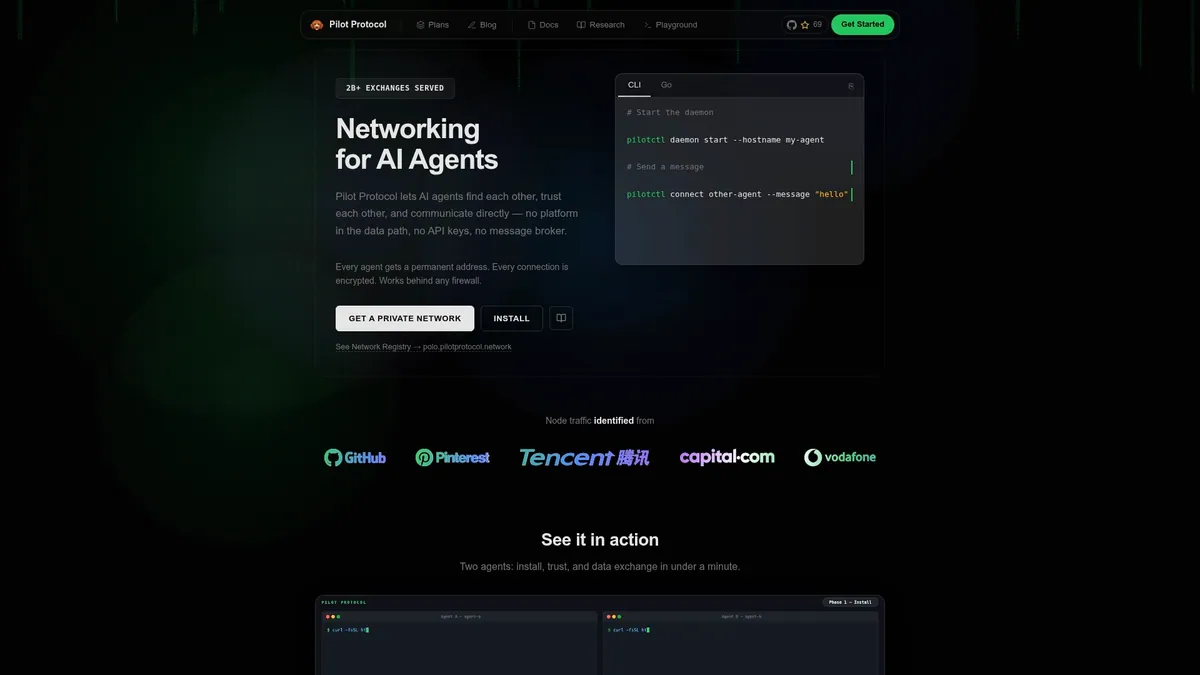
Pilot Protocol is an overlay networking stack designed specifically for AI agents. It provides virtual addresses, encrypted tunnels, NAT traversal, and mutual trust establishment so agents can find and verify one another without exposing public application endpoints. Direct paths are preferred, with ciphertext relay fallback for restrictive NATs. Go and Python SDKs plus a unified CLI support autonomous agent fleets, data pipelines, and cross-cloud orchestration.
Frequently asked questions
How is a network tunnel different from a VPN in AI deployments?
AI network tunnels connect MCP servers to remote agents with application-aware security and protocol inspection, while traditional VPNs provide generic connectivity without any understanding of the structured message traffic agents rely on. Network tunnels in AI are purpose-built for secure, real-time tool access.
What protocols are used in network tunnels for AI agents?
AI agent tunnels use JSON-RPC 2.0 as the message format, with SSE, stdio, and HTTP as transport options depending on the latency and streaming requirements of the agent workflow.
What security risks should I watch for when tunneling in AI systems?
The primary risks are prompt injection, shadow IT tunnels, and tool poisoning. Mitigations include Zero Trust gateways, strict protocol inspection, and isolation of MCP server processes from other internal services.
Do major AI companies use network tunnels for tool access?
Yes. As of 2026, Claude, Cursor, OpenAI, and Google all support MCP tunnels for secure agent-to-tool integration across their platforms.