
Top encrypted tunnel advantages for P2P AI networks

TL;DR:
- Encrypted tunnels secure agent-to-agent communication across multi-cloud and edge environments with confidentiality, integrity, and authentication.
- NAT traversal techniques like UDP hole-punching enable 70% direct connectivity, with relay fallback ensuring universal reachability.
- WireGuard offers efficient, simple, kernel-level encryption, ideal for resource-constrained and containerized agent deployments.
AI agent networks no longer live inside a single data center. They span AWS, GCP, Azure, and edge nodes simultaneously, crossing NAT boundaries and untrusted networks with every message. Securing those peer-to-peer communications is critical, and encrypted tunnels are the foundational building block that makes it practical. This article breaks down the core security, operational, performance, and implementation advantages of encrypted tunnels for decentralized agent systems, so you can make informed architecture decisions backed by evidence.
Table of Contents
- How encrypted tunnels enhance security in AI agent systems
- Operational advantages in decentralized, multi-cloud environments
- Performance and implementation benefits for peer-to-peer networking
- Potential caveats and best practices for encrypted tunnels
- A nuanced take: Encrypted tunnels aren’t magic-context is everything
- Accelerate secure AI networking with Pilot Protocol
- Frequently asked questions
Key Takeaways
| Point | Details |
|---|---|
| Modern cryptography | Encrypted tunnels use up-to-date ciphers to secure peer-to-peer communications in agent-based networks. |
| NAT traversal | Encrypted tunnels can help agents connect reliably even when deployed across restrictive home and cloud environments. |
| Operational efficiency | WireGuard tunnels boost performance and simplify networking for AI agents, especially in containers and edge devices. |
| Limitations exist | Peer IP leaks, UDP-only restrictions, and NAT complexity require thoughtful design and mitigation. |
| No universal solution | Each agent architecture needs a custom mix of tunnels, NAT traversal, and fallback to reach robust autonomy. |
How encrypted tunnels enhance security in AI agent systems
With foundational challenges framed, let’s dissect how encrypted tunnels directly strengthen agent-to-agent security.
Every agent message that crosses the open internet is a potential target. Without encryption, an attacker positioned between two agents can read model outputs, inject instructions, or silently replay stale commands. Encrypted tunnels eliminate that attack surface at the transport layer, before your application logic ever runs.
The three properties you need are:
- Confidentiality: Data is encrypted in transit, so intercepted packets are unreadable without the private key.
- Integrity: Message authentication codes (MACs) verify that each packet arrived unmodified. Any tampering invalidates the MAC and the packet is dropped.
- Authentication: Only agents that hold the correct cryptographic identity can establish a tunnel. Unauthenticated peers are rejected at the handshake.
Modern tunnel implementations like WireGuard deliver all three. WireGuard provides confidentiality, integrity, and authentication through Curve25519 key exchange, ChaCha20 encryption, and Poly1305 authentication. These are not legacy algorithms. Curve25519 is an elliptic curve designed for speed and resistance to side-channel attacks. ChaCha20 is a stream cipher that outperforms AES on processors without hardware acceleration, which matters for edge nodes. Poly1305 provides fast, secure message authentication.
“Encrypted tunnels built on modern cryptography give your agent network a zero-trust foundation by default. Every connection is authenticated and encrypted, regardless of the underlying network.”
This matters for zero-trust architectures. Zero-trust means you never assume a network is safe, even inside a cloud VPC. By forcing end-to-end encryption (E2EE) between every agent pair, you remove implicit trust from the network layer entirely. An agent in one cloud region cannot be spoofed by another process on the same subnet.
You can explore the specific cryptographic methods that underpin these tunnels, and review modern encryption choices like X25519 and AES-GCM for additional context on algorithm selection.
Pro Tip: Rotate agent key pairs on a defined schedule, especially for long-running autonomous agents. Static keys that never change are a larger blast radius if a node is compromised.
Operational advantages in decentralized, multi-cloud environments
With cybersecurity fundamentals in place, the operational strengths of tunnels across clouds and edge environments come to light.
Security properties are only useful if the tunnel actually connects. In multi-cloud and edge deployments, NAT (Network Address Translation) is everywhere. Home-based edge agents, cloud VMs behind load balancers, and containerized workloads all sit behind NAT layers that block inbound connections by default.
Encrypted tunnels solve this with NAT traversal techniques like UDP hole-punching. NAT traversal with relay fallback achieves about a 70% success rate in P2P environments, with relay fallback ensuring connectivity in the remaining cases. That 70% figure is significant: it means most direct agent connections succeed without any relay overhead, keeping latency low and throughput high.
Key operational benefits include:
- Direct cross-cloud connectivity: A single tunnel config connects agents across AWS, GCP, and Azure without a central VPN appliance or shared broker.
- Relay fallback: When direct NAT traversal fails, a relay node forwards traffic, maintaining connectivity in restrictive enterprise or carrier-grade NAT environments.
- Edge and mobile agent support: Agents on intermittent connections reconnect automatically when a tunnel drops, improving uptime for autonomous fleets.
- No central dependency: Removing the central message broker means no single point of failure and no bottleneck at scale.
Statistic: Direct P2P tunnel connections succeed in roughly 70% of NAT scenarios. Relay fallback covers the rest, giving you near-universal reachability across varied network environments.
You can read a detailed breakdown of NAT traversal challenges specific to AI agents, and see how P2P networking for AI architectures handle these scenarios at scale.
Pro Tip: Always implement relay fallback before you need it. Discovering that a cloud provider blocks UDP hole-punching during a production incident is far more costly than configuring a relay node upfront.
Performance and implementation benefits for peer-to-peer networking
Operational resilience aside, developers also reap notable performance and deployment wins from modern encrypted tunnels.

WireGuard’s kernel module implementation is a practical advantage for agent deployments. Because the cryptographic operations run in kernel space, context switching between user space and kernel space is minimized. This directly reduces CPU utilization compared to OpenVPN or IPSec, which is meaningful when you’re running dozens of agent containers on a single node.
| Protocol | CPU overhead | Config complexity | Container friendly | UDP only |
|---|---|---|---|---|
| WireGuard | Low | Simple | Yes | Yes |
| OpenVPN | Medium | Moderate | Partial | No |
| IPSec | High | Complex | Partial | No |
WireGuard’s kernel efficiency makes it well-suited for containers and Kubernetes workloads, with low CPU usage that benefits edge nodes and IoT agents running on constrained hardware.
Here’s a practical deployment sequence for agent tunnel setup:
- Generate a Curve25519 key pair per agent at provisioning time.
- Register each public key with your peer discovery service.
- Configure the WireGuard interface with the peer’s public key and endpoint.
- Set allowed IPs to the agent’s virtual address range only, not a broad CIDR.
- Verify the handshake completes before marking the agent as ready.
- Monitor tunnel health with periodic keepalive packets.
Simplicity is a real advantage at scale. WireGuard’s configuration is minimal compared to IPSec. Fewer config lines mean fewer misconfigurations in large agent clusters.
The one limitation to plan for: WireGuard is UDP-only. Some cloud environments and enterprise firewalls block UDP traffic. In those cases, multi-cloud connectivity requires wrapping tunnel traffic over TCP or using an HTTP-based overlay. You can also explore UDP restrictions and how HTTP overlays handle this constraint.
Potential caveats and best practices for encrypted tunnels
Finally, even robust tunneling has edge cases. Here’s how to sidestep and fix common deployment issues.
Encrypted tunnels are not a complete solution on their own. Three specific issues come up repeatedly in production agent deployments.
| Caveat | Risk level | Mitigation |
|---|---|---|
| Peer IP stored in memory | Medium | Use double-NAT or ephemeral environments |
| UDP blocked by firewall | High | Configure TCP relay or HTTP overlay |
| Fixed cryptography | Low (positive) | No weak algorithm fallback possible |
| No built-in key rotation | Medium | Implement external key lifecycle management |
WireGuard’s fixed cryptography prevents downgrade attacks but stores recent peer IPs in memory, which can be mitigated with double-NAT. The UDP-only transport also limits connectivity through strict TCP firewalls.
Best practices for production agent tunnels:
- Use ephemeral virtual machines or containers so peer IP memory is cleared on teardown.
- Monitor firewall rules across all cloud regions your agents operate in. UDP port availability varies by provider and region.
- Treat the locked cryptography as a feature. WireGuard’s refusal to negotiate weaker algorithms is a security guarantee, not a limitation.
- Build relay fallback into your agent startup sequence, not as an afterthought.
- Audit peer public keys regularly. Revoke keys for decommissioned agents immediately.
For peer IP mitigation strategies in practice, and for NAT traversal strategies that handle strict firewall environments, both resources give you implementation-level detail.
Pro Tip: Combine your tunnel layer with an application-level identity check. Even if a peer establishes a valid tunnel, your agent should verify the peer’s identity token before processing any request. Defense in depth applies here.
A nuanced take: Encrypted tunnels aren’t magic-context is everything
These practical caveats lead to a broader reflection: how should we actually think about encrypted tunnels in AI and agent worlds?
There’s a tendency in distributed systems design to treat encrypted tunnels as a complete answer to agent security and reachability. They’re not. They solve a specific set of problems very well: confidentiality, integrity, authentication, and NAT traversal. But they don’t solve observability, they don’t handle highly restrictive enterprise firewalls without additional relay logic, and they don’t account for cloud provider variance in UDP handling.
The teams that deploy agent networks most reliably treat tunnels as one layer in a modular stack. They pair tunnel encryption with application-level identity verification, build relay fallback in from day one, and instrument their tunnels with health metrics so they know when a connection degrades before an agent fails silently.
The networking challenges in decentralized systems are real and varied. Tunnels address many of them, but adaptive, context-aware implementation is what separates a robust agent network from a fragile one.
Accelerate secure AI networking with Pilot Protocol
If you want to implement what you’ve learned at scale, next-generation solutions can help bridge learning and action.
Pilot Protocol is built specifically for AI agent networks. It handles encrypted tunnel management, NAT traversal, virtual addressing, and relay fallback out of the box, so your team focuses on agent logic rather than networking infrastructure.
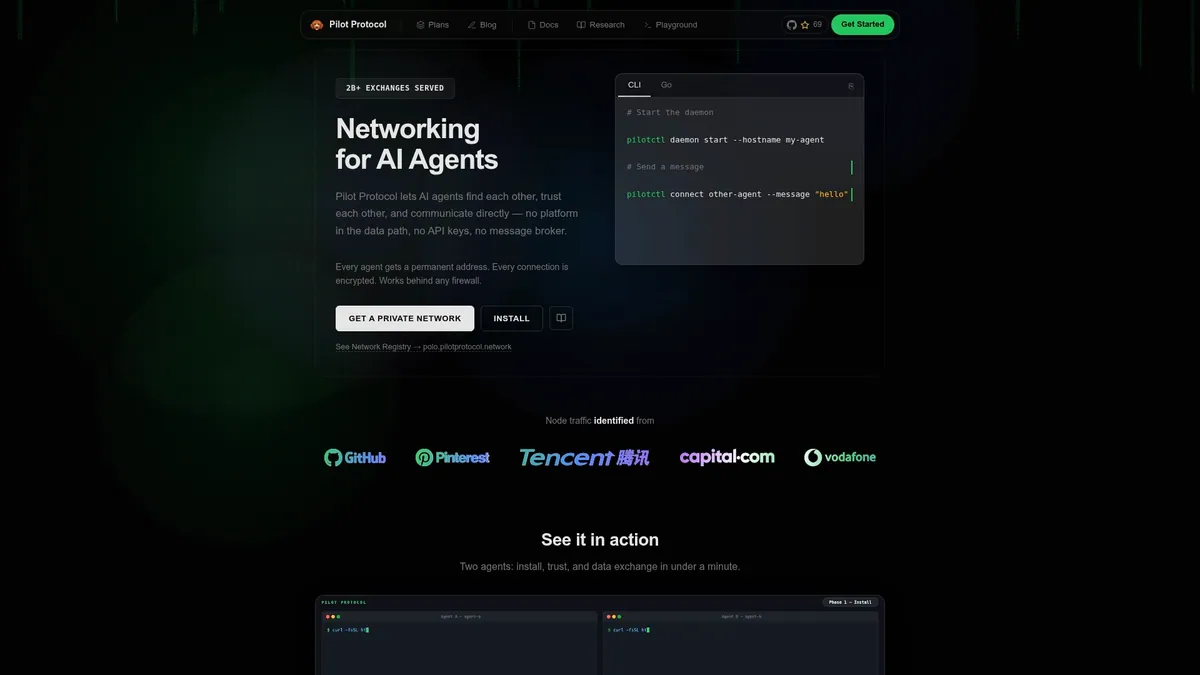
With SDKs for Python and Go and a unified CLI, you can connect agents across AWS, GCP, Azure, and edge environments without deploying or managing a central VPN. Pilot Protocol wraps your existing HTTP, gRPC, and SSH traffic inside its encrypted overlay, making integration with existing systems straightforward. Start building secure, autonomous agent fleets without the infrastructure overhead.
Frequently asked questions
What is an encrypted tunnel in peer-to-peer agent networks?
An encrypted tunnel is a secure communication channel that protects data privacy and integrity between peer agents, using modern cryptography to keep agent traffic encrypted across the open internet.
How do encrypted tunnels help with NAT traversal in multi-cloud environments?
Encrypted tunnels use UDP hole-punching and similar techniques to connect agents behind firewalls, with roughly 70% direct success and relay fallback covering the remaining cases for reliable multi-cloud connectivity.
Why is WireGuard recommended for agent-to-agent encrypted tunnels?
WireGuard offers kernel-level efficiency and low CPU overhead, making it well-suited for AI agents running in containers, Kubernetes clusters, or on resource-constrained edge hardware.
What caveats should developers consider with encrypted agent tunnels?
Developers should plan for peer IP memory storage, UDP-only transport limitations, and ensure relay fallback logic is in place for cloud environments with strict firewall policies.