
Peer-to-peer networking examples every AI engineer should know

TL;DR:
- Proper P2P choices prioritize security, NAT traversal, scalability, and resilience to prevent data loss and security gaps.
- BitTorrent, libp2p, and IPFS exemplify scalable discovery, data exchange, and content addressing for distributed AI systems.
- Operational monitoring and modular, future-proof design are critical for stable, long-term autonomous agent networks.
Choosing the wrong peer-to-peer networking approach for your distributed AI system is not a minor inconvenience. It can mean silent data loss, broken agent coordination, or a security gap that exposes your entire mesh to untrusted peers. Most engineers focus on throughput benchmarks and ignore the deeper questions: How does this protocol handle churn? What happens when an agent sits behind a double NAT? Can this stack scale to thousands of autonomous nodes without a central broker? This article cuts through the noise, walking you through the most relevant P2P architectures, how to evaluate them, and what lessons you can apply directly to your agent infrastructure today.
Table of Contents
- Core criteria for effective peer-to-peer architectures
- Example 1: BitTorrent – High-performance file swarming
- Example 2: libp2p – Modular stack for secure agent communication
- Example 3: IPFS – Distributed content storage and retrieval for autonomy
- Comparison table: BitTorrent vs libp2p vs IPFS for AI networking
- What traditional P2P architecture guides miss-and how to future-proof your design
- Scale your autonomous agent networking-next steps with Pilot Protocol
- Frequently asked questions
Key Takeaways
| Point | Details |
|---|---|
| Criteria matter | Define security, discovery, NAT, and modularity requirements before choosing a P2P protocol. |
| Bittorrent is resilient | Bittorrent combines scalable DHT discovery, incentive alignment, and robust NAT handling for massive swarms. |
| libp2p offers flexibility | Libp2p modular stack powers agent networks with pluggable transports, pubsub, and advanced NAT traversal. |
| IPFS for storage | IPFS uses content addressing and DHTs for reliable, distributed storage, with considerations for persistence and NAT. |
| Practical challenges | Real-world P2P systems require monitoring, edge-case handling, and fallback mechanisms for production reliability. |
Core criteria for effective peer-to-peer architectures
Before picking a protocol, you need a shared framework for evaluation. The wrong checklist leads to costly rewrites. The right one saves months. When assessing any P2P approach for distributed AI or agent-based systems, prioritize these properties:
- Security: Every connection should use encrypted streams. Agents must authenticate each other, not just the transport layer. Hash verification of received data prevents silent corruption.
- Discovery: There are two main flavors. Structured vs unstructured P2P networks trade off routing efficiency for flexibility. Structured networks, especially those using Distributed Hash Tables (DHTs), scale far better for large agent fleets.
- NAT traversal: Most agents in real deployments sit behind firewalls or NAT devices. Hole punching, STUN (Session Traversal Utilities for NAT), and TURN (Traversal Using Relays around NAT) relays must be built in, not bolted on.
- Efficiency: Large-scale data exchange benefits from chunking, rarest-first piece selection, and bandwidth-aware scheduling.
- Resilience: Single points of failure destroy distributed systems. Replication, tit-for-tat incentive mechanisms, and graceful churn handling are non-negotiable for production workloads.
- Modularity: Agent workloads evolve. Your networking stack should allow you to swap transports, upgrade security protocols, or add new discovery mechanisms without rewriting the core.
For secure implementations in distributed systems, prioritize libp2p for modularity and NAT resilience, and use DHTs like Kademlia for scalable discovery. Kademlia’s XOR distance metric gives you O(log N) lookup efficiency, meaning a network of one million nodes still resolves peers in roughly 20 hops.
Pro Tip: Start your architecture review with P2P best practices before committing to a specific protocol. Retrofitting security and NAT handling is significantly harder than building them in from day one.
Agents that skip agent-level access control and rely only on transport encryption are especially vulnerable. Read up on securing AI P2P protocols to understand why layered trust matters in autonomous systems.
With clear criteria in mind, let’s examine real-world P2P examples that demonstrate these properties.
Example 1: BitTorrent – High-performance file swarming
BitTorrent is the most widely studied P2P protocol in existence, and for good reason. Its design decisions around discovery, data exchange, and incentive alignment are directly applicable to AI model distribution, swarm learning, and large-scale data sharding.
Discovery: BitTorrent uses Kademlia DHT for peer discovery with an XOR distance metric, achieving O(log N) lookup efficiency even in networks with millions of peers. Peer Exchange (PEX) supplements this by letting connected peers share their own neighbor lists. Magnet links remove tracker dependency entirely.
The practical result is less dependence on a single tracker. The official BitTorrent DHT specification describes how peers locate one another through the distributed routing table, while magnet links let clients begin discovery from a content identifier.
Data exchange: Rarest-first piece selection and tit-for-tat choking ensure high piece diversity and fair reciprocation across swarms. Rarest-first prevents bottlenecks by prioritizing the least-replicated chunks. Tit-for-tat discourages free-riding by throttling peers who do not contribute upload bandwidth.
- Scales to millions of concurrent peers
- Robust against node churn and partial failures
- NAT traversal via UDP hole punching is a separate BitTorrent extension (BEP 55), layered on top of the core DHT (BEP 5)
- No central server required for discovery in modern implementations
“BitTorrent’s rarest-first and tit-for-tat mechanisms are not just fairness tools. They are reliability primitives that directly map onto multi-agent data distribution scenarios where no single node should hold all the pieces.”
For AI engineers: Think about swarm learning, where model gradients or checkpoints need distribution across hundreds of training nodes. BitTorrent’s chunking model maps directly onto this. Agent file transfer at scale benefits from the same rarest-first logic that makes torrents resilient.
Pro Tip: If you are distributing large model artifacts across a multi-region agent fleet, BitTorrent-style chunking with DHT-based peer discovery can dramatically reduce your coordination overhead compared to centralized object storage with sequential downloads.
Equipped with a criteria set, let’s see how libp2p operationalizes these in a modular, agent-ready stack.
Example 2: libp2p – Modular stack for secure agent communication
libp2p started as the networking layer for IPFS but has become the de facto framework for any serious P2P application. IPFS, Ethereum 2.0, and Polkadot all rely on it. For AI agent architectures, its modularity is the key differentiator.
Pluggable transports and security:
- Choose your transport: TCP, QUIC, or WebSockets depending on environment constraints.
- Layer encryption automatically using Noise or TLS 1.3 via protocol negotiation.
- Add mDNS for local discovery or Kademlia DHT for wide-area routing.
- Enable GossipSub pubsub for broadcast messaging across agent clusters.
This modularity means you can build a no-server agent network that works in cloud VMs, edge nodes, and containerized environments without changing your application logic.

NAT traversal results:
| Mechanism | Success rate | Notes |
|---|---|---|
| DCUtR hole punching | 70% ±7.1% | Over 4.4M attempts |
| TCP vs QUIC | ~70% (equivalent) | 97.6% of successful connections land on the first attempt |
| Relay fallback | ~100% reachability | Higher latency |
libp2p’s modular NAT traversal via hole punching, STUN, TURN, and relay ensures agents behind restrictive firewalls still connect reliably.
Edge cases you must handle: Stream closure blocking on unresponsive peers is a known issue fixed with read deadlines. IPv6/IPv4 relay failures and AllAddrs including private IP ranges can cause connection instability. IPNS record drops without active bootstrap connections are another gotcha in long-running agent deployments.
For decentralized AI solutions and P2P federated learning, libp2p gives you a production-grade foundation without locking you into a single transport or security model.
Pro Tip: Always set explicit stream read and write deadlines in your libp2p agent code. Goroutine leaks from blocked stream closures are the number-one cause of memory exhaustion in long-running agent mesh deployments.
IPFS builds on libp2p, offering a content-first approach particularly suited to distributed storage and retrieval for agents.
Example 3: IPFS – Distributed content storage and retrieval for autonomy
IPFS is not just a file system. For distributed AI agents, it is a content-addressed data layer that eliminates location dependency. Instead of asking “where is this data?”, agents ask “what is this data?” using Content Identifiers (CIDs).
How it works:
- CIDs hash content deterministically, so data retrieval is integrity-verified by default
- Kademlia DHT for content discovery via CIDs, with Bitswap for block exchange and Merkle DAGs for data structure
- Bitswap negotiates block exchange between peers without a central coordinator
- Pinning services ensure persistence when the providing agent goes offline
Strengths for AI workloads:
- Immutable, verifiable dataset versioning for training pipelines
- Agents can request model artifacts by CID without knowing which peer holds them
- Data deduplication is automatic at the block level
Where IPFS requires extra care:
NAT traversal in P2P is the biggest operational challenge. DCUtR hole punching achieves 70% ±7.1% success across 4.4M attempts, with TCP and QUIC performing equivalently and 97.6% succeeding on the first try. Agents behind restrictive NAT still need relay configuration.
Persistent agent addressing matters too. IPNS (InterPlanetary Name System) provides mutable pointers to CIDs, but record propagation can lag in sparse networks. For mission-critical AI pipelines, combine pinning with active bootstrap connections.
Comparison table: BitTorrent vs libp2p vs IPFS for AI networking
To decide which pattern to implement, use the following side-by-side comparison.
| Property | BitTorrent | libp2p | IPFS |
|---|---|---|---|
| Discovery | Kademlia DHT + PEX | Kademlia DHT + mDNS | Kademlia DHT |
| NAT traversal | UDP hole punching | DCUtR, STUN, TURN, relay | DCUtR via libp2p |
| Security | Optional encryption | Noise/TLS, mandatory | Noise/TLS via libp2p |
| Best AI use case | Model artifact swarming | Agent mesh communication | Versioned dataset storage |
| Operational complexity | Low | Medium | Medium to high |
DHT+PEX+Magnet links reduce time-to-first-byte by 4.1x versus tracker-only discovery, with 22% less RAM usage for peer discovery in modern clients. That kind of efficiency matters when you are managing hundreds of agent nodes.
What traditional P2P architecture guides miss-and how to future-proof your design
Most P2P architecture articles stop at the checklist. They tell you to use DHTs, enable encryption, and handle NAT. What they do not tell you is that production failures almost never come from missing these basics. They come from the operational layer nobody documented.
We have seen AI agent mesh networks destabilized not by a protocol flaw, but by missed stream closures accumulating over days, eventually exhausting goroutine pools. Private IP ranges leaking into address announcements caused relay routing loops that were nearly impossible to trace without structured logging.
The lesson: monitoring and observability are not optional extras. Build them in before your first production deploy. Log every connection event, stream lifecycle, and peer churn event from day one.
For zero-config NAT traversal scenarios, your fallback relay must be tested under load, not just in happy-path integration tests. Relay latency under congestion behaves very differently than in a dev environment.
Future-proofing your design means building for modularity at every layer. If your transport is swappable, your security layer is pluggable, and your discovery mechanism is independent of your data exchange logic, you can upgrade each component without a full rewrite. Follow networking best practices to structure your system for long-term operational stability, not just initial correctness.
Scale your autonomous agent networking-next steps with Pilot Protocol
The architectures above give you the building blocks. Pilot Protocol brings the network-layer pieces together for AI agent fleets and distributed systems; production use still depends on workload-specific policy, authorization, and validation.
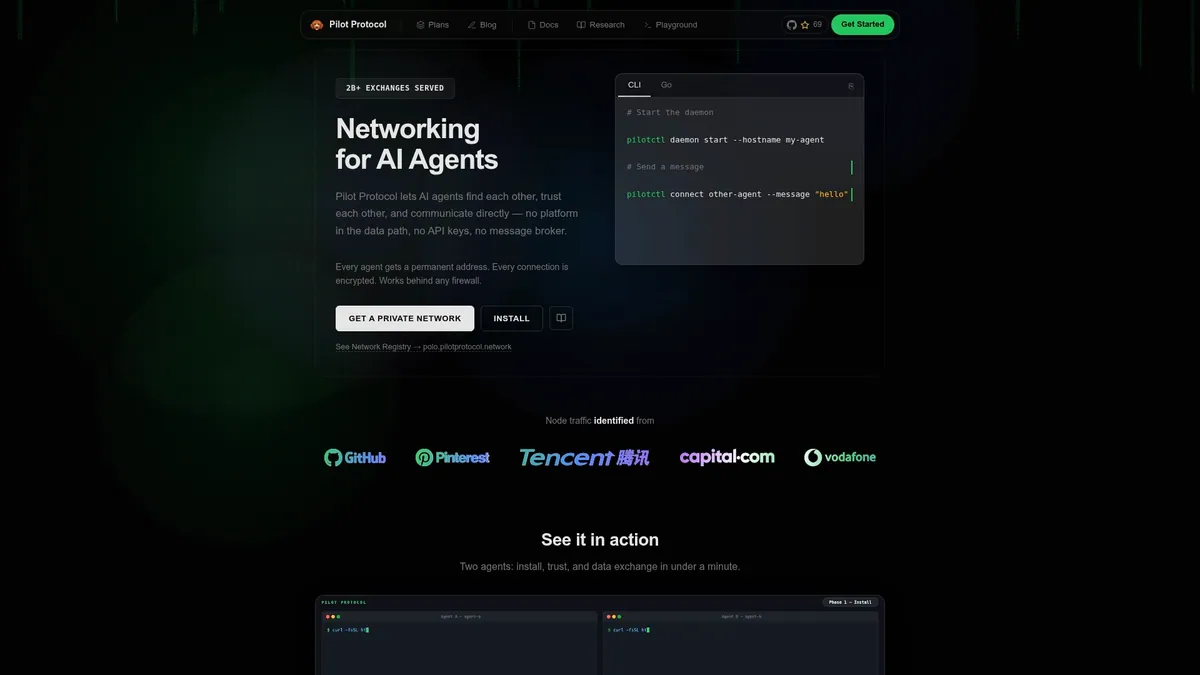
With Pilot Protocol, you get persistent virtual addresses, encrypted tunnels, automatic NAT traversal, and trust establishment across multi-cloud and cross-region deployments. Direct paths are preferred, with ciphertext relay fallback when necessary. You can wrap existing HTTP, gRPC, or SSH traffic inside the overlay without deploying a workflow-specific message broker; firewall and egress requirements still depend on the selected transport mode.
Start with the P2P agent communication guide to see how a serverless agent mesh comes together in practice, then explore the API docs and CLI to prototype your first secure agent network.
Frequently asked questions
What is the main advantage of Kademlia DHT in peer-to-peer networks?
Kademlia DHT enables scalable and efficient peer discovery using an XOR distance metric, achieving O(log N) lookup efficiency even across networks with millions of active peers. This makes it practical for large autonomous agent fleets that need to locate peers without a central registry.
How do peer-to-peer systems handle NAT traversal?
Techniques like hole punching, STUN, TURN, and relay fallback are used to navigate NAT boundaries. DCUtR hole punching achieves 70% ±7.1% success across 4.4M tested attempts, with relay providing near-total coverage for remaining cases.
Why use content addressing in P2P storage like IPFS?
Content addressing with CIDs and Merkle DAGs guarantees data integrity and enables immutable retrieval without depending on a central server, which is critical for reproducible AI training pipelines.
What efficiency benefits does BitTorrent’s tit-for-tat strategy provide?
Tit-for-tat choking discourages free-riding by throttling peers who do not reciprocate uploads, which optimizes data distribution speed and fairness across all nodes in the swarm.
What is a key edge case when using libp2p in AI-driven autonomous systems?
Stream closure blocking on unresponsive peers is a common stability issue. Setting explicit read deadlines on all streams prevents goroutine leaks and memory exhaustion in long-running agent deployments.