
Persistent Addresses for Distributed AI Agents

TL;DR:
- Traditional IP and DNS addressing are unreliable for dynamic multi-cloud distributed systems.
- Persistent addresses are stable, cryptographically linked identities that remain valid across network changes.
- Implementing persistent addresses enables secure, decentralized, and scalable agent communication in cloud environments.
Most teams building distributed systems assume that DNS or a load balancer is enough to keep agents reliably connected. That assumption breaks down fast. When agents spin up across AWS, GCP, and Azure, shift between regions, or restart after failure, their IP addresses change. DNS records lag behind. Message brokers add latency and single points of failure. The result is dropped connections, failed handshakes, and agents that can’t find each other when it matters most. This article walks you through why persistent addresses solve these problems, how they work in practice, and what you need to implement them securely across multi-cloud and peer-to-peer environments.
Table of Contents
- The challenges of addressing in distributed and autonomous agent systems
- What are persistent addresses? Key concepts and practical frameworks
- Implementing persistent addressing in P2P and multi-cloud environments
- Security and scalability: Best practices for persistent addressing
- Why persistent addresses will reshape distributed systems
- Explore solutions for autonomous agent networking
- Frequently asked questions
Key Takeaways
| Point | Details |
|---|---|
| Traditional addressing breaks | Static IPs and DNS don’t scale reliably for distributed or autonomous systems. |
| Persistent addresses explained | Persistent addresses provide stable, secure, and unique agent identification across networks and clouds. |
| Multi-cloud and P2P ready | Persistent addressing enables seamless communication between agents in multi-cloud, peer-to-peer environments. |
| Security and scalability focus | Best practices combine persistent addresses with robust identity verification for secure, scalable solutions. |
| Future-proof architectures | Persistent addressing is foundational for self-healing networks and resilient AI agent ecosystems. |
The challenges of addressing in distributed and autonomous agent systems
Building on the introduction’s setup, let’s explore why persistent addresses are not just a technical curiosity but a practical necessity.
Traditional IP and DNS addressing was designed for relatively stable infrastructure. Distributed systems and autonomous agents operate in a completely different reality. Agents scale up and down dynamically, move between cloud providers, and restart frequently. Every time that happens, their network identity shifts.
Unstable endpoints complicate agent communication and scalability in distributed systems, making reliable peer-to-peer coordination extremely difficult to achieve at scale.
This is not a minor inconvenience. When an agent loses its address, every other agent that depended on it must rediscover it. In large fleets, that rediscovery process creates cascading delays and failures.
Here are the core challenges you face with traditional addressing in distributed environments:
- Dynamic IP churn: Cloud instances get new IPs on restart. Containers in Kubernetes clusters are especially prone to this.
- DNS propagation lag: Even with short TTLs, DNS changes take time to propagate globally, leaving stale records in circulation.
- Cross-cloud identity gaps: An agent on GCP has no native way to prove its identity to an agent on Azure without additional infrastructure.
- NAT traversal complexity: Agents behind NAT or firewalls are effectively invisible to peers unless you build explicit traversal logic.
- Security surface expansion: Ephemeral addresses make it harder to enforce access control, because the identity of an endpoint keeps changing.
For P2P solutions in AI architectures, the addressing layer is foundational. If you can’t reliably locate and verify an agent, you can’t build trust, you can’t route data, and you can’t scale your system. The AI networking challenges that teams encounter most often trace back to this single root cause: addresses that don’t persist.
Autonomous agents add another layer of complexity. Unlike human-operated servers, agents make decisions and initiate connections without manual intervention. They need to find peers, verify their identity, and exchange data autonomously. That requires an addressing model that is stable, verifiable, and independent of the underlying network topology.
What are persistent addresses? Key concepts and practical frameworks
Understanding the problem prepares us to look at what persistent addresses actually are and how they change the game.
A persistent address is a stable, unique identifier assigned to an agent or node that remains valid regardless of network changes, cloud migrations, or session restarts. It is not tied to a specific IP, region, or provider. Think of it as a permanent identity for your agent, separate from the physical or virtual network interface it happens to be using at any given moment.

Address resolution in scalable distributed applications is evolving rapidly, and persistent addresses represent the current best practice for autonomous agent communication.
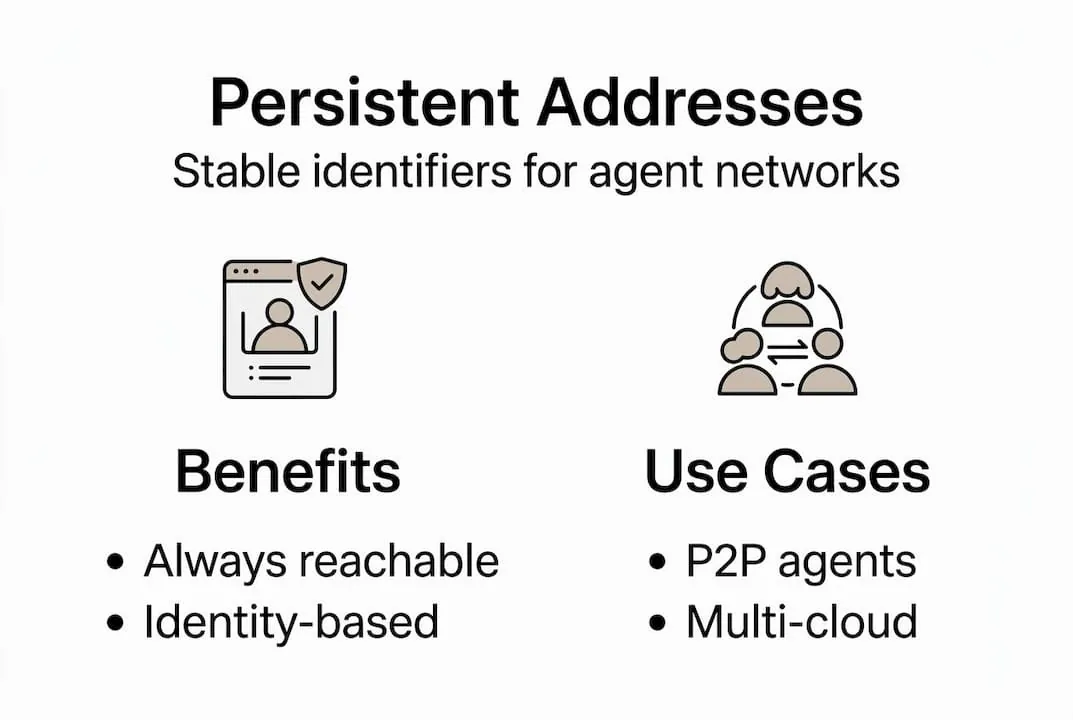
Here is how persistent addresses compare to the alternatives:
| Address type | Stability | Identity-bound | Cross-cloud | Cryptographic verification |
|---|---|---|---|---|
| Dynamic IP | Low | No | No | No |
| Static IP | Medium | No | No | No |
| DNS hostname | Medium | Partial | Partial | No |
| Persistent address | High | Yes | Yes | Yes |
The key characteristics that define a persistent address include:
- Identity anchoring: The address is derived from or cryptographically linked to the agent’s identity, not its network location.
- Portability: The address follows the agent across clouds, regions, and network restarts.
- Verifiability: Other agents can confirm the address is legitimate without a central authority.
- Longevity: The address remains valid for the lifetime of the agent or service, not just for a session.
For agent networking in distributed AI, two frameworks dominate. The first is identity-based addressing, where each agent gets an address derived from a cryptographic key pair. The second is overlay network addressing, where a virtual address space sits on top of the physical network, decoupling logical identity from physical location.
Pro Tip: When designing your addressing scheme, generate agent identities at provisioning time and store the private key securely. Never let the orchestration layer regenerate keys on restart. Consistent key material is what makes the address truly persistent. You can also integrate with enterprise identity systems to tie agent addresses to organizational identity providers.
Implementing persistent addressing in P2P and multi-cloud environments
Having defined persistent addresses and their frameworks, now we dive into real implementation tactics for P2P and multi-cloud environments.
Modern distributed architectures abstract identity and addressing to reduce complexity and increase reliability, and that abstraction is exactly what persistent addressing delivers in practice.
Here is a practical sequence for deploying persistent addresses across a multi-cloud agent fleet:
- Generate a cryptographic identity at agent creation. Use an Ed25519 or similar key pair. The public key becomes the basis for the agent’s persistent address.
- Register the address in an overlay network or directory service. This is where tools like Pilot Protocol’s virtual address layer come in. The registry maps the persistent address to the agent’s current network endpoint.
- Configure NAT traversal. Agents behind firewalls need hole-punching or relay support. Build this into your networking layer from the start, not as an afterthought.
- Establish mutual TLS or equivalent encrypted tunnels. Every connection between agents should be authenticated and encrypted using the persistent identity as the trust anchor.
- Implement address refresh without identity change. When an agent’s physical IP changes, it should update its location in the registry while keeping the same persistent address. Peers reconnect automatically.
- Test failover explicitly. Simulate agent restarts, cloud region failures, and network partitions. Verify that peers re-establish connections using the persistent address without manual intervention.
For cross-cloud agent networking, the biggest pitfall is assuming that cloud-native service discovery tools like AWS Cloud Map or GCP Service Directory will handle cross-provider routing. They won’t. You need an overlay or abstraction layer that operates independently of any single provider.
Pro Tip: If you want to run an agent network without cloud dependency, design your persistent address registry to be distributed and self-hosted. Avoid any single point that a cloud provider controls. Pair this with secure AI communication protocols to ensure that your addressing layer doesn’t become a security liability.
Security and scalability: Best practices for persistent addressing
With implementation covered, it’s critical to highlight how security and scalable design go hand-in-hand with persistent addressing.
Secure, scalable AI networking requires robust address and identity management at every layer of your stack. Persistent addresses help, but only if you secure them properly.
The primary security risks in persistent addressing systems include:
- Key compromise: If an agent’s private key is stolen, an attacker can impersonate that agent using its persistent address. Rotate keys on a schedule and revoke compromised identities immediately.
- Address spoofing: Without cryptographic verification, an attacker could claim a legitimate persistent address. Always verify address ownership through signature challenges.
- Registry poisoning: A compromised address registry can redirect agents to malicious endpoints. Use distributed or cryptographically signed registries.
Here is how leading identity frameworks map to persistent addressing needs:
| Framework | Use case | Persistent address support |
|---|---|---|
| SPIFFE/SPIRE | Workload identity in Kubernetes | Strong, via SVIDs |
| Microsoft Entra ID | Enterprise agent identity | Strong, via managed identities |
| OPA (Open Policy Agent) | Policy-based access control | Complementary, not native |
| Pilot Protocol overlay | Autonomous agent P2P networking | Native persistent virtual addresses |
For scalability, follow these practices:
- Cache address resolution locally. Agents should not query the registry on every connection. Cache resolved addresses with a reasonable TTL and refresh in the background.
- Shard your registry. For large fleets, a single registry becomes a bottleneck. Partition by region, domain, or agent group.
- Use gossip protocols for propagation. Instead of centralized updates, let agents propagate address changes peer-to-peer. This scales naturally and reduces single points of failure.
- Monitor address churn. High rates of address updates signal instability in your infrastructure. Track this metric and alert on anomalies.
Integrating AI networking best practices with your persistent addressing strategy means treating identity and addressing as first-class concerns, not infrastructure afterthoughts. Pair your addressing layer with secure communication protocols to close the gap between identity and encryption.
Why persistent addresses will reshape distributed systems
Most guides treat persistent addressing as a routing optimization. That framing is too narrow. Persistent addresses are actually the foundation for a fundamentally different model of distributed computation.
When every agent has a stable, verifiable identity that travels with it, you stop building systems that depend on centralized coordinators. Agents can form direct trust relationships, negotiate connections autonomously, and self-heal when peers go offline. That is not an incremental improvement. It is a structural shift toward truly decentralized, autonomous infrastructure.
The guides that miss this point focus on implementation details and skip the architectural implication: ephemeral addressing forces centralization. Every time an address changes, something has to track that change. That something becomes a dependency, a bottleneck, and a failure point. Persistent addresses eliminate that dependency entirely.
Looking ahead, persistent addresses are the enabling layer for zero-trust agent networks, self-organizing agent ecosystems, and long-lived autonomous pipelines that operate without human intervention. If you are building decentralized communication protocols for AI systems today, the addressing model you choose now will determine how far your architecture can scale tomorrow. Get it right from the start.
Explore solutions for autonomous agent networking
Pilot Protocol is built specifically for the challenges you have been reading about. It provides persistent virtual addresses, encrypted tunnels, NAT traversal, and mutual trust establishment for autonomous agents and distributed systems across any cloud environment.
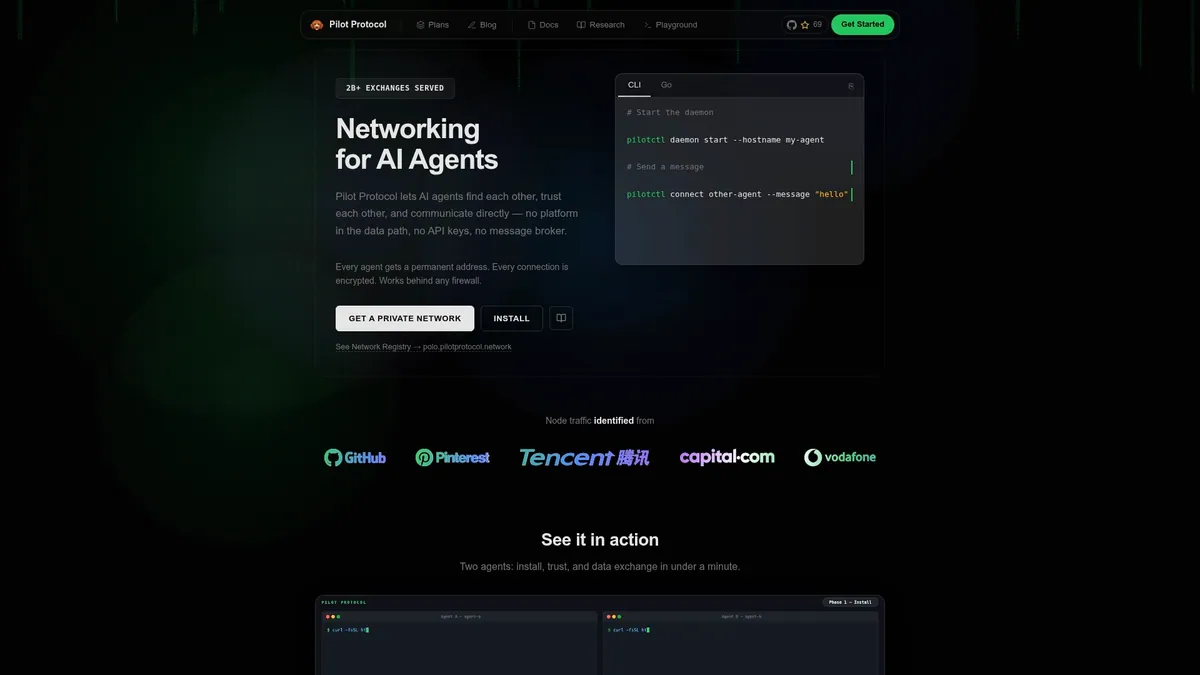
If you are ready to move from theory to practice, explore Pilot Protocol to see how persistent addressing, direct-preferred connectivity, encrypted relay fallback, and agent communication fit together. Validate the resulting architecture against your own availability and governance requirements.
Frequently asked questions
What exactly is a persistent address?
A persistent address is a unique, stable identifier for an agent or node in a distributed system that remains valid across networks, platforms, and sessions. As address resolution techniques evolve, persistent addresses are becoming the standard for scalable autonomous agent communication.
How do persistent addresses enhance security in distributed systems?
Persistent addresses support stronger identity verification and help prevent impersonation, spoofing, and unauthorized access in decentralized environments. Robust address and identity management is a core requirement for secure, scalable AI networking.
Can persistent addresses work across AWS, GCP, and Azure?
Yes. Modern approaches abstract identity and addressing at the overlay level, enabling agents to communicate seamlessly across all major cloud platforms without dependency on VPNs or provider-specific service discovery.
What are best practices for implementing persistent addresses?
Use identity-based frameworks with strong cryptographic anchors and integrate with solutions like SPIFFE or Entra ID for robust agent identification. Secure, scalable AI networking requires treating address and identity management as foundational, not optional.