
Agent communication security: best practices for AI developers

TL;DR:
- Securing agent-to-agent communication in decentralized AI systems is crucial due to active threats like replay, spoofing, and data leakage that target message exchanges and infrastructure. Implementing robust measures such as freshness controls, MLS group messaging, mutual TLS, and model-level leakage audits is essential for a holistic security approach. Continuous, integrated security reviews and infrastructure support like Pilot Protocol help maintain resilient and trustworthy multi-agent networks.
Securing agent-to-agent communication in decentralized systems is one of the most underestimated engineering challenges in AI infrastructure today. As multi-agent architectures grow more complex, attack surfaces expand across every message exchange, trust handshake, and data stream. Replay attacks, identity spoofing, man-in-the-middle interception, and model-level data leakage are not theoretical risks. They are active threats that target the seams between agents, protocols, and infrastructure. This article gives you a clear, prioritized set of techniques to address those risks directly, with actionable guidance you can apply to your stack right now.
Table of Contents
- Establishing secure criteria for agent communication
- Tip 1: Prevent replay attacks with freshness controls
- Tip 2: Use authenticated and privacy-preserving group messaging
- Tip 3: Strong authentication and trust bootstrapping for agents
- Advanced defense: Mitigating model-level data leakage
- Why agent communication security requires a holistic mindset
- Next steps: Deploy peer-to-peer security with Pilot Protocol
- Frequently asked questions
Key Takeaways
| Point | Details |
|---|---|
| Prioritize identity and trust | Strong authentication and explicit trust models are the foundation for secure agent communication. |
| Defend against replay | Implement freshness controls with nonces and timestamps to mitigate replay attacks. |
| Adopt modern group protocols | Use up-to-date group messaging standards like MLS for forward secrecy and robust authentication. |
| Address model-level risks | Encrypt protocols but also audit agent dialog for accidental leaks to prevent unintended data exposure. |
Establishing secure criteria for agent communication
Before you pick a protocol or write a line of code, you need a clear threat model. Knowing what you are defending against shapes every architectural decision that follows.
The major security risks in agent-based systems include:
- Identity spoofing: A malicious agent impersonates a legitimate one to gain trust or access.
- Man-in-the-middle (MitM) attacks: An attacker intercepts and potentially alters messages between agents.
- Replay attacks: A captured valid message is retransmitted to trigger unintended behavior.
- Integrity loss: Message contents are altered in transit without detection.
- Information leakage: Sensitive data is exposed through protocol metadata or agent dialog.
To address these risks, your communication design must meet five minimum criteria. Confidentiality ensures messages cannot be read by unauthorized parties. Integrity ensures messages are not altered in transit. Authenticity ensures you know who sent each message. Trust establishment ensures agents can verify one another before exchanging data. Non-leakage ensures that neither protocol metadata nor agent behavior reveals protected information.
The fifth criterion is where many teams fall short. Review the secure communication essentials for a full breakdown of what each criterion means in practice.
Critical insight: Protocol-level encryption alone does not protect against model-level leakage. Research on the security of agent networks documents information leakage between cooperating agents, confirming that the agents themselves can inadvertently expose secrets even when the channel is fully encrypted.
This is the core reason why building a secure agent network requires both protocol-level controls and model-level auditing. Basic encryption is necessary. It is not sufficient. Use the network security checklist to validate your current posture against each of these criteria systematically.
Tip 1: Prevent replay attacks with freshness controls
Replay attacks are deceptively simple and consistently dangerous. An attacker captures a legitimate message, such as an authorization token or a task instruction, and retransmits it later. The receiving agent has no way to distinguish the replay from a fresh request unless freshness controls are in place.
Here is a practical sequence you can implement in any agent messaging system:
- Attach a nonce to every outgoing message. A nonce (number used once) is a randomly generated value that the recipient tracks. If the same nonce arrives twice, the message is rejected. Replay attack defenses consistently recommend nonces and unique identifiers as a primary control.
- Include a timestamp with a strict validity window. Set a maximum age, typically between 30 and 300 seconds depending on your latency tolerance. Messages outside that window are rejected automatically.
- Add a unique request ID to every API call or task dispatch. This complements the nonce and allows you to correlate logs, detect duplicates, and trace replay attempts back to their origin.
- Apply message integrity checks or digital signatures. A signature over the message body, nonce, and timestamp ensures that a replayed message cannot be altered to bypass validation. If any field is tampered with, the signature fails.
- Use expiring session tokens tied to agent identity. Short-lived tokens reduce the window of opportunity for replay. Rotate them frequently, especially after any suspected compromise.
Apply this sequence alongside the zero trust communication framework, where every message is treated as untrusted until validated.
Pro Tip: Use time-bounded tokens with a maximum lifetime of 60 seconds for high-frequency agent pipelines. Combine them with nonce tracking on the receiver side to eliminate both replay and race conditions in concurrent agent workflows.
Tip 2: Use authenticated and privacy-preserving group messaging
Single-agent-to-agent communication is manageable. Multi-agent group communication is significantly harder to secure because every participant is a potential attack vector and the complexity of key management grows with the group size.

Messaging Layer Security (MLS) is the current standard for authenticated and privacy-preserving group messaging. The MLS protocol is defined in RFC 9420, and its architecture (RFC 9750) explicitly states that MLS protects against eavesdropping, tampering, and message forgery while providing both forward secrecy and post-compromise security.
Here is what MLS gives you at a glance:
| Security property | What it means for your agents |
|---|---|
| Confidentiality | Only group members can decrypt messages |
| Authentication | Every message is tied to a verified sender identity |
| Forward secrecy | Past messages stay secure even if a key is later compromised |
| Post-compromise security | Future messages recover security after a member’s key is exposed |
| Replay protection | Sequencing controls limit insider replay within defined session bounds |
For most distributed AI systems, the forward secrecy and post-compromise security properties are the most practically valuable. If an agent is compromised, MLS limits the blast radius. Past messages cannot be decrypted with the current key material. Future messages re-establish security once the compromised agent is removed from the group.
When to use MLS vs. legacy alternatives:
- Use MLS when you have three or more agents collaborating in a persistent session.
- Use MLS when compliance or audit requirements demand demonstrable cryptographic security.
- Consider a simpler bilateral TLS setup only for one-to-one agent communication with low group membership churn.
- Avoid legacy group messaging approaches based on shared symmetric keys. They do not provide forward secrecy or post-compromise recovery.
Read more about implementing decentralized messaging protocols to see how MLS fits into broader P2P agent architectures.
Tip 3: Strong authentication and trust bootstrapping for agents
Authentication is where most agent networks are weakest in practice. You can have perfect encryption and still be vulnerable if you cannot reliably verify the identity of the agent you are talking to.
Agent identity authentication and cross-agent trust are consistently identified as top risks in multi-agent systems. The recommended cryptographic mitigations, mutual TLS and digital signatures, address these risks directly.
Here is how the three main approaches compare:
| Method | Security strength | Setup complexity | Best use case |
|---|---|---|---|
| Mutual TLS (mTLS) | High | Medium to high | Service-to-service agent calls |
| Digital signatures | High | Medium | Asynchronous task dispatch |
| Simple bearer tokens | Low | Low | Internal dev/test environments only |
Key points on each approach:
- Mutual TLS requires both the client and server agents to present valid certificates. This eliminates one-sided trust and provides strong identity assurance at the transport layer.
- Digital signatures work well when agents are communicating asynchronously or when messages pass through intermediaries. Each message carries a cryptographic proof of origin.
- Certificate pinning adds another layer by tying an agent’s identity to a specific certificate or public key. It prevents trust issues caused by compromised certificate authorities.
- Bearer tokens alone are never sufficient for production agent networks. They provide zero authenticity guarantees and are trivially stolen or replayed without additional controls.
Practical trust bootstrapping tips:
- Provision agent certificates at deployment time using a private certificate authority (CA) under your control.
- Rotate certificates on a schedule, not just when a compromise is detected.
- Use short-lived certificates (24 hours or less) for ephemeral agents in CI/CD pipelines.
- Revoke certificates immediately when an agent is decommissioned, upgraded, or suspected of compromise.
- Never hardcode public keys in agent source code. Use a secrets management service or a dedicated key store.
Understanding agent trust models in depth will help you choose the right bootstrapping strategy for your specific deployment topology.
Advanced defense: Mitigating model-level data leakage
Protocol security addresses the network layer. But the agents themselves introduce a separate class of risk that most infrastructure engineers overlook until it is too late.
Benchmarks show models can leak sensitive information during cooperation dialogs between agents. This happens when one agent, attempting to be helpful to another, shares context it should not. The encrypted channel is intact. The sensitive data leaks anyway, carried in the message content itself.
This is a fundamentally different problem from network-level interception, and it requires a different set of defenses.
Here are the advanced controls you should implement:
- Audit your agent dialog datasets for leakage patterns. If you fine-tuned or prompted your agents on real data, check whether that data surfaces in agent-to-agent conversations under adversarial conditions.
- Apply context-aware least privilege to agent inputs and outputs. Each agent should only receive the context it needs to complete its assigned task. Filter inputs before they reach the model and outputs before they leave it.
- Implement prompt filtering and output sanitization layers. Wrap model calls in a validation layer that screens outgoing messages for sensitive patterns such as PII, credentials, and internal system identifiers.
- Run simulated cooperation attack scenarios. Create adversarial test agents that attempt to elicit sensitive information from your production agents through seemingly legitimate dialog. Review the multi-agent data leakage guide for structured test methodologies.
- Isolate agent memory and shared context. Do not allow agents to accumulate and forward context beyond what is needed for the immediate task. Use scoped context windows that clear between sessions.
Important reminder: Encrypting the channel solves network interception. It does not solve model behavior. Both layers need independent controls.
Pro Tip: Schedule simulated attack scenarios against your agent fleet at least quarterly. As your agent logic evolves or models are updated, previously safe prompting patterns can become leakage vectors. Treat this like penetration testing for your model layer.
Why agent communication security requires a holistic mindset
Here is the reality that most security checklists skip over: you cannot secure agent communication by picking the right protocol and calling it done. The threat model for AI agent networks is not static. It shifts as your agents evolve, as attack methods improve, and as new model behaviors emerge from updates or fine-tuning.
The failure pattern we see repeatedly is what you might call security drift. A team launches a well-designed system. mTLS is configured, nonces are in place, MLS is running. Six months later, a new agent type is added with a simplified authentication setup for speed. Certificates are not rotated on schedule. The dialog filtering layer is not updated after a model upgrade. The protocol is still technically correct but the overall posture has degraded significantly.
Holistic security means aligning three things simultaneously: your protocol design, your infrastructure configuration, and your model behavior. Most teams are strong on one or two of these. Few are consistent across all three. The mismatched assumptions between agents and the protocols they run on are consistently one of the most common failure points we observe in deployed systems.
The most overlooked pitfall is not the sophisticated attack. It is the gradual erosion of controls that were working fine at launch. Review your practical network security posture on a defined cadence, not only when something breaks. Build protocol review into your standard release process. Treat agent communication security as a living system requirement, not a one-time implementation task.
Next steps: Deploy peer-to-peer security with Pilot Protocol
The techniques in this article, replay prevention, MLS group messaging, mTLS authentication, and model-level leakage controls, require solid infrastructure to implement reliably at scale.
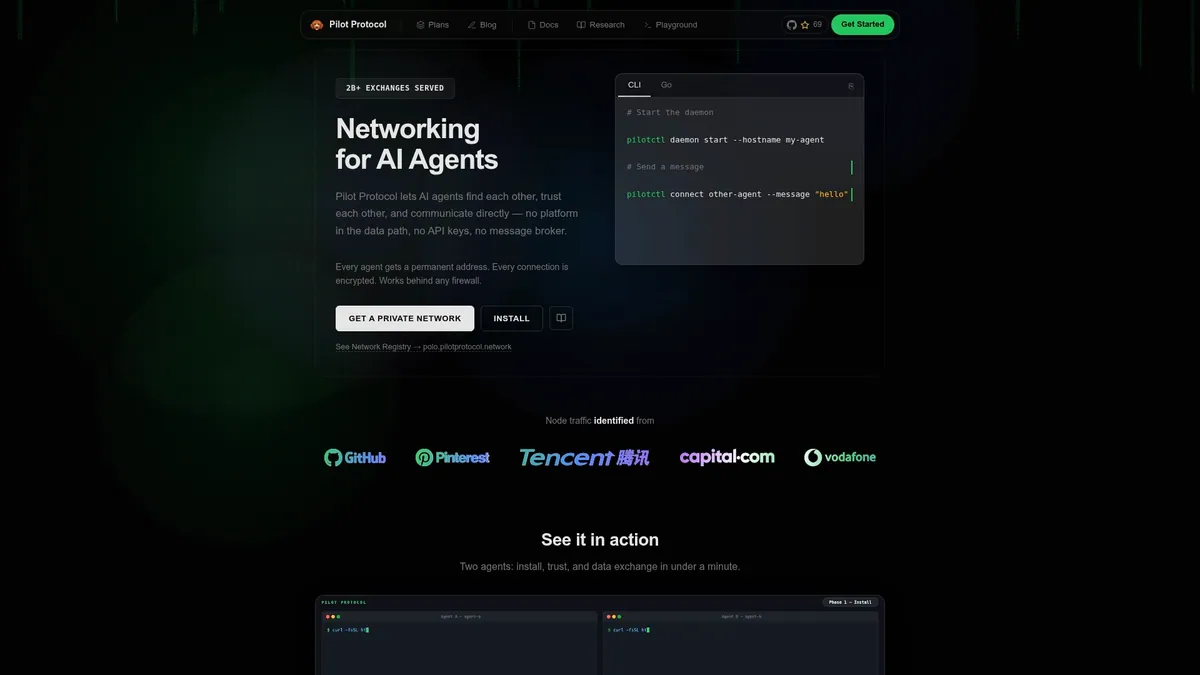
Pilot Protocol is built to support exactly these requirements. The platform provides encrypted peer-to-peer tunnels, mutual trust establishment, and persistent virtual addresses for your agent fleet, removing the need for centralized message brokers that create single points of failure or interception. With X25519-encrypted tunnels, NAT traversal, and cross-cloud connectivity, you get the infrastructure layer your security controls actually need. Start with the peer-to-peer agent security overview to see how Pilot Protocol maps to the defense layers covered here, then connect your first secure agent pair in minutes using the Python or Go SDK.
Frequently asked questions
What is the most effective way to prevent replay attacks in agent communication?
The best approach is to combine nonces and timestamps with digital signatures, ensuring each message carries a unique, time-bounded proof that cannot be reused.
How does Messaging Layer Security (MLS) help secure group communication?
MLS provides confidentiality, integrity, authentication, forward secrecy, and post-compromise security, making it the strongest available standard for multi-agent group messaging.
Why is authentication important between AI agents?
Agent identity risks including spoofing and MitM attacks are among the top threats in decentralized systems. Strong authentication ensures every message comes from a verified source.
Can encrypted channels fully prevent sensitive data leakage between agents?
No. Models can leak sensitive information through message content itself, even on fully encrypted channels. Protocol security and model behavior auditing must be implemented independently.
What protocols provide both confidentiality and forward secrecy for agent messaging?
MLS is specifically designed for confidential, authenticated, and forward-secret group communication, making it the recommended choice for production multi-agent environments.