Overlay networking for automation: Secure AI agent solutions

TL;DR:
- Autonomous AI agents require persistent identities, zero-trust routing, and dynamic policy enforcement not provided by traditional overlays.
- Choosing overlay technologies depends on latency, security needs, and multi-cloud portability, with simpler overlays often preferable for scalable AI systems.
- Operational best practices include auditing CIDR overlaps, managing agent sprawl, and prioritizing policy governance to ensure reliable, secure overlay networks.
Most engineers assume that dropping a VPN or a Kubernetes CNI into their stack is enough to secure agent-to-agent communication. It is not. Autonomous AI agents operate across clouds, spawn dynamically, and need persistent, verifiable identities that traditional overlays were never designed to provide. The gap between legacy networking and what modern agentic systems actually require is wider than most teams realize. This article breaks down overlay networking fundamentals, compares the leading technologies, and gives you a practical framework for building secure, scalable overlays for AI automation in 2026.
Table of Contents
- Understanding overlay networking for automation
- Key overlay technologies for AI automation
- Security and zero-trust in overlay networks
- Operational pitfalls and practical solutions
- Our perspective: What most engineers miss about overlay networking automation
- Learn more and unlock secure overlay automation
- Frequently asked questions
Key Takeaways
| Point | Details |
|---|---|
| Agentic overlays advantages | Agentic overlays provide identity, zero-trust, and adaptive protocols for secure multi-agent automation. |
| Performance trade-offs | Cilium offers best L4 performance; Istio Ambient delivers advanced L7 mesh capabilities but adds latency. |
| Portable security policies | GUE tunneling with authorization keys enables consistent policy enforcement across infrastructures at minimal latency. |
| Operational risk mitigation | Governance, regular audits, and CIDR checks prevent routing failures and agent sprawl. |
| Implement with intent | Design overlays for agent identity and policy orchestration before optimizing for speed or features. |
Understanding overlay networking for automation
An overlay network is a virtual network built on top of an existing physical or logical network. It abstracts away the underlying infrastructure and lets you define your own routing, addressing, and security rules. For traditional workloads, this works well. For autonomous AI agents, it falls short fast.
AI agents are not static services. They spin up on demand, migrate across regions, communicate with dozens of peers simultaneously, and often operate without human supervision. Standard overlays assume relatively fixed endpoints and human-managed policies. Agentic systems break both assumptions.
What you actually need for autonomous agent automation includes:
- Persistent virtual addresses that follow an agent regardless of where it runs
- Standardized identity so each agent can prove who it is before any data flows
- Zero-trust routing that verifies every connection, not just the perimeter
- Support for agent-to-agent (A2A) protocols that go beyond simple HTTP tunneling
- Dynamic policy enforcement that scales with agent fleet size
The industry is catching up. As noted by ONUG, agentic AI overlays treat autonomous AI agents as first-class network citizens with standardized identity, zero-trust routing, and A2A protocols. This is a meaningful shift from treating agents like ordinary microservices.
Intent-driven overlays go further. Instead of defining static rules, you declare what agents are allowed to do and with whom. The overlay enforces that intent automatically, even as agents scale or move. This is fundamentally different from manually managing firewall rules or IP allowlists.
The key insight is this: your overlay should understand agent identity and intent, not just IP addresses and ports. Anything less creates security gaps that grow as your fleet scales.
For a deeper look at how A2A and MCP protocols fit into this picture, and why zero-trust communication is the right baseline for agent networks, those resources are worth reviewing before you finalize your architecture.
Key overlay technologies for AI automation
Not all overlay tools are built for the same job. Here is a practical comparison of the leading options and where each fits in an AI automation stack.
Kubernetes CNIs like Cilium (eBPF), Calico (BGP), and Flannel (VXLAN) provide overlay networking at the pod level, while service meshes add L7 features with additional overhead. Choosing the wrong layer costs you either performance or visibility.

| Technology | Layer | Strengths | Weaknesses |
|---|---|---|---|
| Cilium (eBPF) | L3/L4 | Low latency, kernel-level policy | Limited native L7 features |
| Calico (BGP) | L3 | Simple routing, scalable | Less dynamic policy support |
| Flannel (VXLAN) | L2/L3 | Easy setup, broad compatibility | Minimal security features |
| Istio Ambient | L4/L7 | Rich mesh features, mTLS | Higher CPU/memory overhead |
| GUE + Auth Keys | L3 to L7 | Portable policy, multi-cloud | Requires careful key management |
Here is how to think about your choice:
- Start with Cilium if you need low-latency L4 enforcement and kernel-level observability without sidecar overhead.
- Use Istio Ambient when you need rich L7 traffic management, retries, and detailed telemetry across a complex mesh.
- Consider Calico for straightforward BGP-based routing in environments where you control the underlying network.
- Add GUE tunneling with authorization keys when you need portable policy enforcement that works across clouds and bare metal.
For multi-agent system networking, the right choice often combines a fast L4 CNI with a lightweight policy layer rather than a full service mesh. Full meshes add latency and resource cost that agent-heavy workloads feel quickly.
Pro Tip: Do not choose your overlay based on vendor marketing or benchmark headlines alone. Evaluate based on your specific policy enforcement needs and how complex your mesh topology will actually become. A simpler overlay with strong governance beats a feature-rich one you cannot manage.
For teams building secure AI systems automation, the operational cost of maintaining a complex mesh often outweighs its benefits at early fleet sizes.
Security and zero-trust in overlay networks
Security in overlay networks for AI agents is not just about encryption. It is about identity, authorization, and portable policy enforcement that works consistently across every cloud and region your agents touch.
The core building blocks of a secure agentic overlay are:
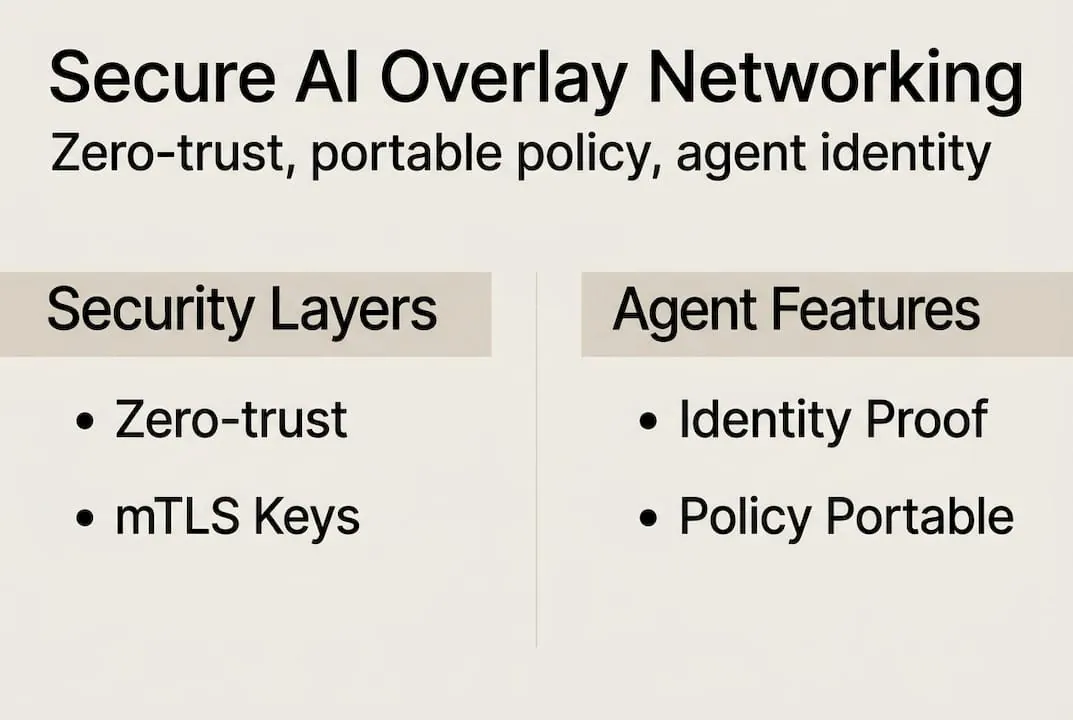
- Mutual TLS (mTLS): Every agent connection is authenticated in both directions. No agent can impersonate another.
- Authorization keys: Short-lived or scoped credentials that control which agents can join which network segments.
- Standardized identity: Each agent carries a verifiable identity that policies reference, not just an IP address.
- L3 to L7 policy enforcement: Security rules apply from the network layer up through the application layer.
One of the most practical advances in this space is GUE (Generic UDP Encapsulation) tunneling with authorization keys. GUE tunneling with authorization keys enables portable L3 to L7 policy enforcement across infrastructures while adding less than 1ms of latency. That is a strong trade-off for the security guarantees you get.
| Security mechanism | Latency added | Policy scope | Multi-cloud portable |
|---|---|---|---|
| mTLS only | Low | L4 to L7 | Yes |
| GUE + Auth Keys | Under 1ms | L3 to L7 | Yes |
| IPSec tunnels | Medium | L3 | Partial |
| VXLAN (no auth) | Very low | L2 to L3 | Yes, but insecure |
For multi-cloud environments, portable policy is the critical factor. Kubernetes-native network policies work well inside a single cluster but break down when agents span AWS, GCP, and Azure simultaneously. GUE-based overlays with centralized policy stores solve this by decoupling policy from the underlying cloud provider.
Building secure infrastructure for AI agents means treating every agent connection as untrusted by default and verifying it explicitly. Pair this with decentralized communication protocols to remove single points of failure from your trust chain.
Operational pitfalls and practical solutions
Even well-designed overlays fail in production. The failure modes are usually not architectural. They are operational. Here are the most common issues and how to address them.
CIDR overlaps are the most frequent cause of silent routing failures. CIDR overlaps cause routing failures when Docker’s default 172.17.0.0/16 range collides with VPC or Transit Gateway subnets. Service mesh sidecars can double CPU and memory consumption. Agent sprawl without governance creates conflicting policies that are hard to trace.
Here is a practical checklist for robust overlay operations:
- Audit CIDR ranges before deploying any new agent cluster or cloud environment. Document every range in a central registry.
- Set resource limits on sidecar containers. Uncapped sidecars silently consume node capacity and degrade agent performance.
- Use a governance model for agent identity. Every agent should be issued a scoped identity at launch, not inherit a broad one.
- Monitor policy conflicts with automated tooling. Manual review does not scale past a few dozen agents.
- Run regular sprawl audits. Identify agents that are no longer active but still hold network policies.
- Test failover paths. Overlay tunnels can silently degrade. Verify that fallback routes work before you need them.
Pro Tip: Always audit your overlays for CIDR conflicts and sprawl risk before scaling your agent fleet. A conflict that is harmless at 10 agents becomes a production outage at 200.
Addressing AI networking challenges early in your design phase saves significant remediation time later. And if you are weighing the operational cost of encrypted tunnels, the advantages of encrypted tunnels for peer-to-peer agent networks far outweigh the overhead when implemented correctly.
Our perspective: What most engineers miss about overlay networking automation
Most teams spend their energy benchmarking throughput and comparing vendor feature lists. That is understandable. Performance matters. But in our experience, the overlays that fail in production do not fail because they picked the wrong protocol. They fail because policy orchestration and agent governance were treated as afterthoughts.
Speed is easy to optimize later. Governance is not. Once you have hundreds of agents operating across clouds with ad hoc policies, retrofitting a coherent identity and authorization model is painful and slow.
The engineers who get this right design for agent identity first. They ask: how does each agent prove who it is, what is it allowed to reach, and who can revoke that access? Then they pick the overlay that best enforces those answers.
Agentic overlays offer intent-driven, adaptive security that static tunnels simply cannot match. But that advantage only materializes if you invest in the policy layer, not just the transport layer. Your overlay is only as resilient as its weakest policy, not its fastest protocol.
Explore decentralized networking for AI to see how this principle applies at scale.
Learn more and unlock secure overlay automation
If you are ready to move from theory to implementation, Pilot Protocol provides encrypted tunnels, persistent virtual addresses, NAT traversal, and mutual trust establishment for AI agent fleets across cloud and regional boundaries.
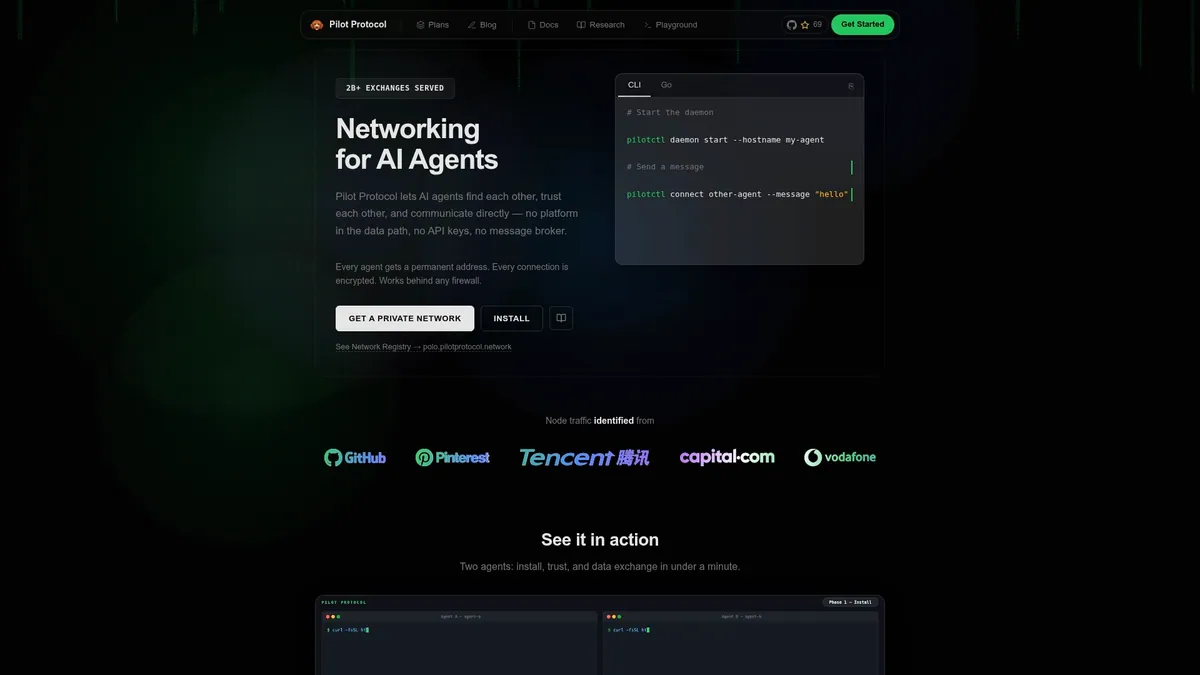
Python and Go SDKs plus a unified CLI let you manage encrypted tunnels without standing up a workflow-specific message broker. Pilot Protocol prefers direct peer paths and retains ciphertext relay fallback, and can wrap existing HTTP, gRPC, and SSH traffic inside the overlay.
Frequently asked questions
What makes agentic AI overlays different from standard overlays?
Agentic overlays treat autonomous agents as first-class network citizens, enabling standardized identity and zero-trust communication across multi-cloud environments, unlike standard overlays that rely on static IP-based rules.
How does overlay networking improve security for autonomous agents?
Overlay networks use authorization keys, standardized identity, and mTLS to enforce portable security policies. GUE tunneling with authorization keys enables portable L3 to L7 policy enforcement across any infrastructure with minimal latency.
Which overlay network tools offer the best performance for AI automation?
Cilium (eBPF) delivers lower L4 latency than Istio Ambient, especially for policy-heavy workloads, but Istio Ambient excels at rich mesh features and detailed L7 observability for larger deployments.
What are the most common operational issues in overlay networking for automation?
CIDR overlaps, agent sprawl, and sidecar resource overhead are the most frequent challenges. Strong governance models and regular audits are the most effective mitigations.